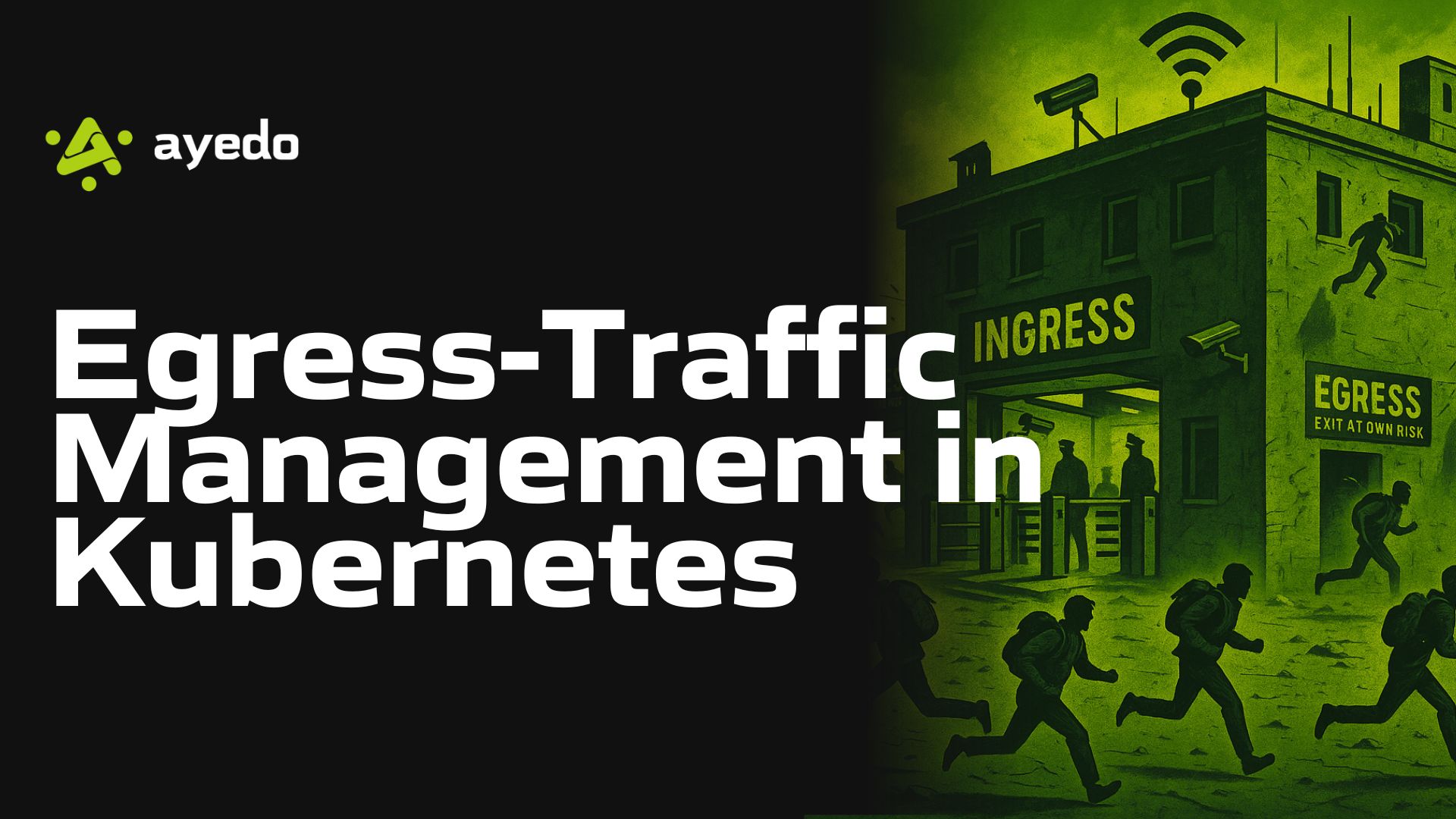
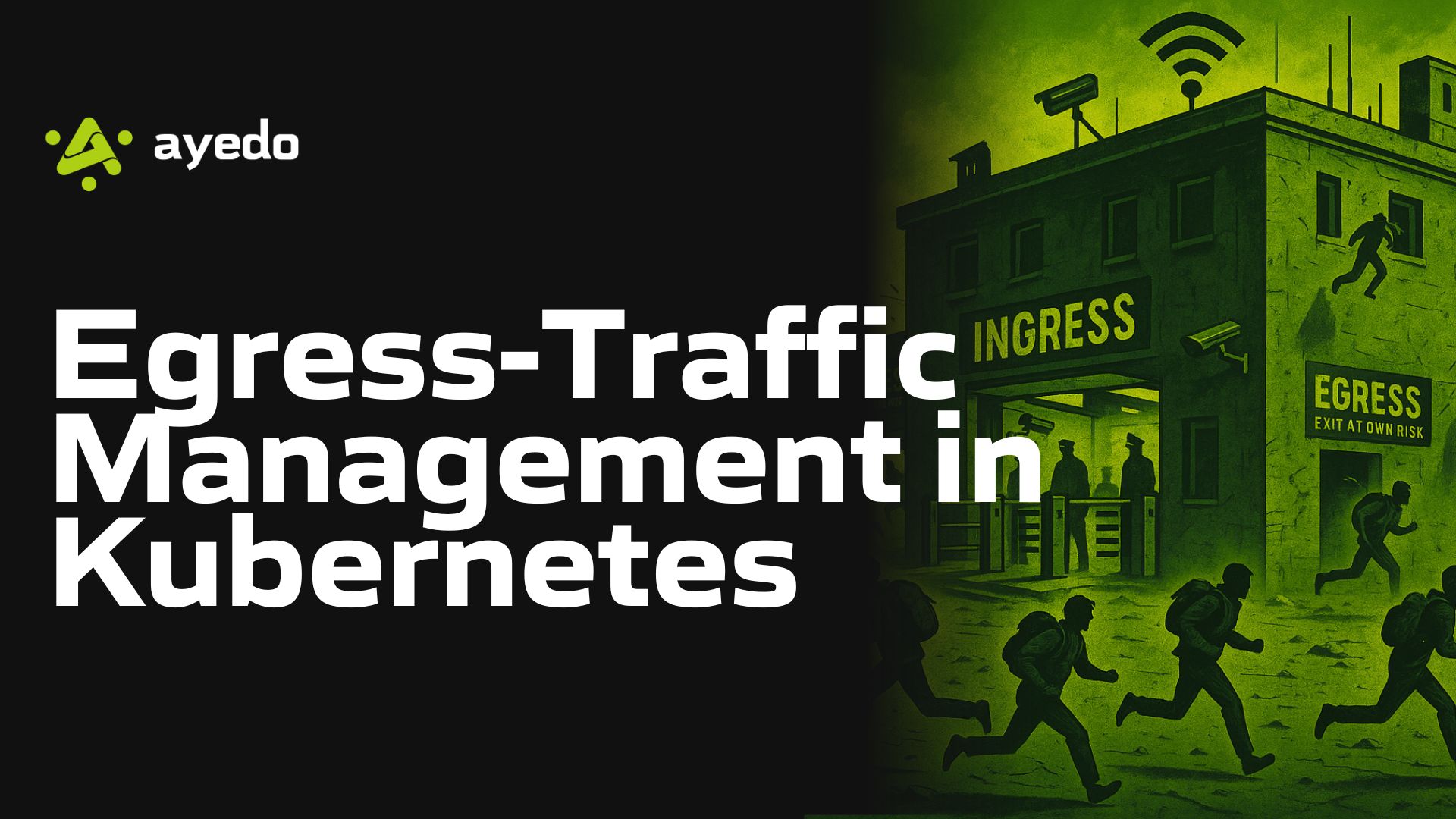
Kubernetes has provided proven mechanisms for years to manage incoming traffic into a cluster. Ingress controllers serve as a defined "bottleneck" through which external requests enter and are handled with clear rules – such as for routing, TLS, or authentication. However, the situation for outgoing traffic, known as egress traffic, is less clear. By default, egress traffic leaves the cluster via the node where the pod initiating the connection is running. There is no central control instance comparable to the ingress controller.
For companies with compliance requirements or complex network scenarios, this poses a problem: outgoing traffic should be traceable, controllable, and, if necessary, routed through specific IP addresses. In this article, we present two approaches to solving this – Cilium Egress Gateway and kube-vip – and examine their advantages and disadvantages in practical use.
The Problem with Egress Traffic in Kubernetes
Status quo
- Each pod can initiate outgoing connections by default.
- Traffic leaves the cluster on the node where the pod is running.
- The source IP of the outgoing traffic therefore corresponds to the IP of the node.
Challenges
- Traceability: It is difficult to identify which pod established which external connection.
- Rule sets: Firewalls and external systems often expect fixed, known source addresses.
- Compliance: In regulated environments, egress traffic must be centrally controllable and verifiable.
While ingress is clearly structured through controllers, egress is fragmented and unregulated in standard operation.
Solutions for Egress Traffic
1. Cilium Egress Gateway
Cilium is a CNI (Container Network Interface) that uses eBPF to efficiently and granularly control network issues in Kubernetes. With the Egress Gateway, Cilium offers the ability to route outgoing traffic through dedicated gateways within the cluster.
Functionality
- Pods can be assigned to specific egress gateways via Kubernetes resources.
- These gateways are special nodes or pods through which all traffic to the external network is routed.
- This allows fixed source IPs to be defined and enforced.
Advantages
- Granular control: Selective use, e.g., per namespace or label.
- Centralization: Outgoing traffic can be bundled over defined nodes.
- Integration in policies: In combination with Cilium Network Policies, complex rules can be mapped.
- eBPF performance: Very low latency, as it is implemented directly in the kernel.
- Audit & Monitoring: With Hubble, Cilium provides an integrated solution for monitoring egress connections, including audit logs and flow analysis.
Disadvantages
- Complexity: Introducing Cilium as a CNI is a major architectural decision.
- Dependency: Functionality is tied to the Cilium ecosystem.
- Know-how requirement: eBPF and Cilium specifics require deeper network knowledge.
- IP address management: Nodes that are to function as egress gateways must have the required source IPs preconfigured. This requires additional coordination with network or IP address management.
2. kube-vip
kube-vip was originally developed as a solution for load balancing and VIP (Virtual IP) management in Kubernetes clusters. In addition to ingress and control plane scenarios, kube-vip can also be used to manage egress traffic.
Functionality
- kube-vip provides a virtual IP through which egress traffic leaves the cluster.
- Pods communicate as usual, but the outgoing traffic is rewritten over the defined VIP.
- External systems thus see a uniform, fixed source IP.
- The assignment of VIPs is done via the Kubernetes LoadBalancer mechanism, so no manual IP preconfiguration on the nodes is necessary.
Advantages
- Simple implementation: kube-vip is lightweight and quickly integrated.
- Stable source IP: Firewalls and external systems benefit from consistent identity.
- Flexibility: Can be used alongside other CNIs.
- Automated IP handling: Using the Kubernetes LoadBalancer mechanism reduces manual management effort.
Disadvantages
- Less granular: Control is via a common VIP, not selectively per namespace or pod.
- Single point of failure: High availability requires additional safeguarding.
- Limited functionality: kube-vip solves the IP problem but offers fewer deep integration options than Cilium.
- Monitoring: Unlike Cilium with Hubble, kube-vip does not come with integrated features for egress transparency or audit logs. External monitoring tools need to be supplemented here.
Comparison Cilium Egress Gateway vs. kube-vip
| Criterion | Cilium Egress Gateway | kube-vip |
|---|---|---|
| Complexity | High (Cilium introduction necessary) | Low (easy to integrate) |
| Granularity | Selective (namespace/label-based) | Global (uniform VIP) |
| Performance | Very high (eBPF-based) | Dependent on IP handling |
| Dependency | Strongly tied to Cilium | Independent, standalone |
| Use Case | Complex multi-tenant/policy scenarios | Uniform IP for external systems |
| IP Address Management | Manual preconfiguration of IPs on gateway nodes | Automated assignment via Kubernetes LoadBalancer |
| Monitoring & Auditing | Integrated via Hubble | External tools required |
Conclusion
Managing egress traffic in Kubernetes is not a peripheral issue but a central element for security, compliance, and stability. While ingress has been cleanly abstracted by controllers for years, egress requires additional solutions.
- Cilium Egress Gateway is the right choice for organizations already using Cilium or needing granular, high-performance traffic flow. The interplay with Hubble offers a clear advantage for transparency and auditing.
- kube-vip is suitable when the primary goal is to provide a uniform source IP for the cluster – with relatively low effort and without manual IP management.
Both approaches show that egress traffic can also be structured and rule-based controlled in Kubernetes – the choice depends on the degree of control needed, the existing runtime environment, and organizational requirements.