How the ayedo Sovereignty Score Provides Guidance
Digital sovereignty is politically mandated and has long been more than an abstract guideline in regulatory terms. Yet, it remains elusive for many organizations, especially when it comes to assessing their own starting point.
In practice, there is much discussion about data sovereignty, vendor lock-in, and European alternatives. What is often missing is a reliable classification of one's own system landscape: Which parts of the IT are actually interchangeable? Where are the critical dependencies? And where is the ability to act less than previously assumed?
This is exactly where the ayedo Sovereignty Score comes in.
Why Digital Sovereignty Often Remains Vague in Everyday Life
Many companies have a basic understanding of what digital sovereignty means. It becomes more challenging when it comes to specific evaluation within their own operations.
The crucial questions are rarely theoretical but very practical:
- Who controls identities and access?
- Where is business-critical data stored?
- How flexible is the infrastructure really in case of an emergency?
- Which platforms or providers are practically irreplaceable?
- How strongly are development, operations, and governance tied to specific ecosystems?
Without a structured view of these points, digital sovereignty often remains a strategic aspiration without operational connectivity.
Why We at ayedo Make the Topic Consciously Concrete
At ayedo, we deal with precisely these questions every day—in customer projects, in architectural decisions, and in the regulatory context.
A clear pattern emerges repeatedly: It is significantly easier to get started when one's own situation is initially visible and assessable in a structured manner. Not as a theoretical maturity model, but as a practical assessment with a result that objectifies discussions and prepares decisions.
That's why we developed the ayedo Sovereignty Score.
The ayedo Sovereignty Score: A Compact Assessment with Substance
The ayedo Sovereignty Score evaluates digital sovereignty across six key areas:
- Applications
- Data Management
- Infrastructure
- Identity & Access Management
- Development
- Governance
This structure is oriented towards real IT landscapes and the fields where dependencies typically arise or are overlooked.
Why Some Areas Are Weighted More Heavily
Not every area has the same impact on actual sovereignty. Therefore, we have weighted Infrastructure, Data Management, and Identity & Access Management more heavily.
The reason is simple: These domains significantly determine how independent, controllable, and resilient a system landscape really is. Those who do not control identities themselves, do not sufficiently manage data, or have little room for maneuver in infrastructure are only limitedly sovereign, even if individual applications seem interchangeable.
30 Questions That Make Your Starting Point Visible
The assessment includes 30 targeted questions that address precisely these critical points.
It's not about ideal images but about the real feasibility in one's own environment:
- How are identities managed?
- Where and under what conditions is data stored?
- How portable are workloads and platforms?
- What dependencies exist with individual providers?
- How are development processes, governance, and operating models structured?
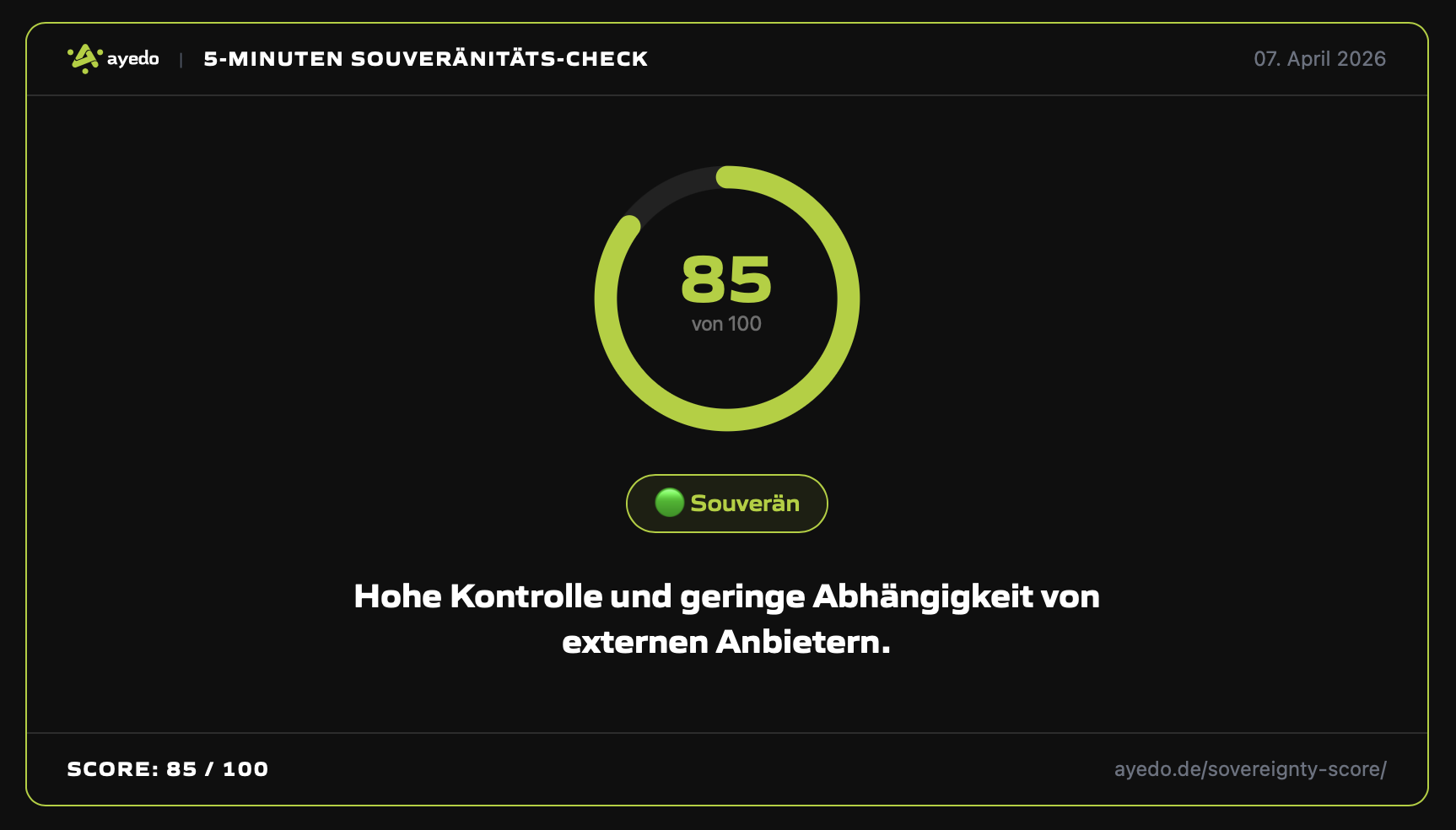
In the end, this results in a score between 0 and 100.
More Important Than the Number: The Composition of the Result
A numerical score provides orientation. However, what matters is not just the final value, but how it is achieved.
The result reveals:
- where there is already a solid foundation,
- where structural dependencies exist,
- and where deeper analyses or concrete measures are advisable.
Especially the more heavily weighted areas shape the overall assessment more strongly. This is deliberately chosen because these are where the greatest levers for true digital sovereignty lie.
Low Barriers, Direct Entry
The ayedo Sovereignty Score is deliberately designed to be used without friction:
- no registration
- no preparation
- no additional organizational effort
The assessment can be started directly and provides a structured result in a short time. This makes it suitable for both an initial overview and as an entry point into further architectural, compliance, or transformation discussions.
From Assessment to the Next Decision
A good score alone does not change an IT landscape. The result becomes relevant when concrete next steps can be derived from it.
This is exactly what the ayedo Sovereignty Score is intended for: not just for classification, but as a basis for decision-making. It shows where dependencies exist, which areas should be prioritized, and where further investments or analyses are particularly worthwhile.
Thus, a strategic term becomes an operationally usable starting point.
Why the Topic Is Gaining Importance Right Now
With NIS2, DORA, and the Data Act, regulatory requirements are noticeably changing. Digital sovereignty is thus becoming increasingly verifiable—and in many cases, a relevant prerequisite for resilience, compliance, and long-term controllability.
At the same time, technological dependency on individual platforms and providers continues to grow in many organizations. It is all the more important to be able to evaluate one's own position not just intuitively, but in a structured manner.
Conclusion: Sovereignty Begins with Transparency
Those who want to seriously advance digital sovereignty need more than guidelines. The first step is a realistic view of one's own starting point.
The ayedo Sovereignty Score was developed precisely for this: quickly executable, clearly structured, and with a result that provides reliable orientation.
The effort is minimal. The gain in insight can be significant.
Check It Yourself Now
If digital sovereignty is to be more than a strategic term for you, it is worth taking a concrete look at your own system landscape.
The ayedo Sovereignty Score offers a direct entry point for this: