Discover our latest articles about cloud-native technologies, Kubernetes, DevOps, and modern software development. From practical tutorials to in-depth analyses.
France is taking digital sovereignty seriously. The government has announced plans to phase out Windows in administration and replace it with Linux. Leading the charge is the digital agency Dinum, with other key players like the cybersecurity agency and state procurement to follow. A concrete migration plan is expected by fall 2026.
Digital sovereignty has been a focus of political and regulatory initiatives in Europe for years. With tools like the Digital Services Act (DSA) and the Digital Markets Act (DMA), the EU has consciously begun to set global standards—particularly in dealing with dominant platforms.
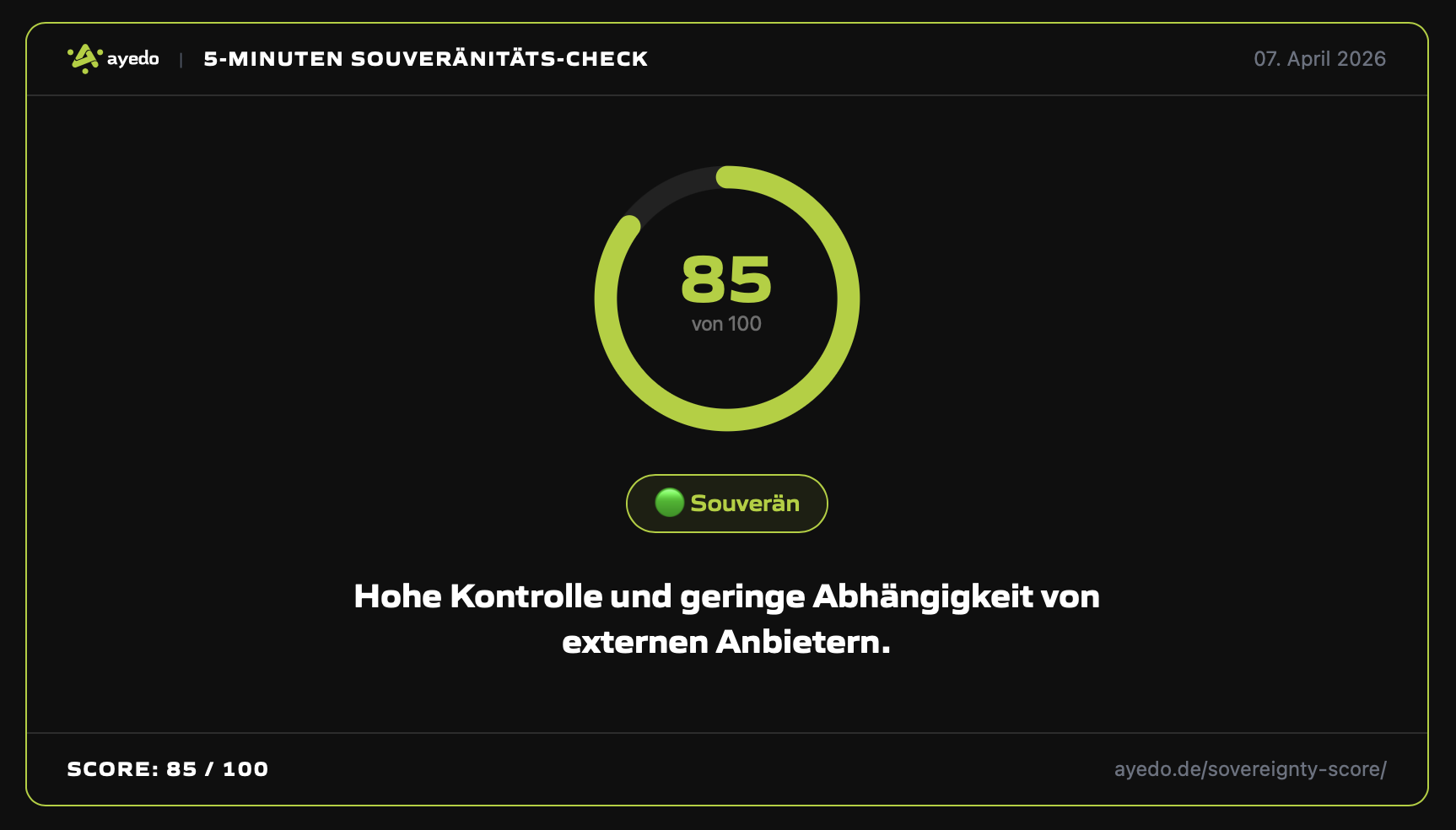
Digital sovereignty is politically mandated and has long been more than an abstract guideline in regulatory terms. Yet, it remains elusive for many organizations, especially when it comes to assessing their own starting point.
In a multi-region architecture, "configuration drift" is the greatest enemy of resilience. Drift occurs when an urgent hotfix is applied at location A, a firewall rule is adjusted, or a certificate is renewed—and one forgets to replicate this change at location B. In a critical situation, traffic may then switch to a region that is not ready, is outdated, or simply does not function.
In the world of Critical Infrastructures (KRITIS), having a sophisticated high availability concept in the drawer is not enough. Auditors and regulators today demand the **technical proof** that theoretical fail-safety is effective in practice. A disaster recovery plan that is tested only once a year (or not at all) is considered a high risk from a regulatory perspective.
In the traditional IT world, maintenance windows are often a necessary evil. Operating system updates, Kubernetes upgrades, or critical database patches are usually performed at night or on weekends to minimize user disruption. However, in a KRITIS environment that requires 24/7 availability, this model poses a high risk: if something goes wrong during maintenance, the system comes to a halt, and redundancy is often suspended during the process.
In the world of critical infrastructures (KRITIS), the success of a disaster recovery concept is often measured by hard metrics like the RTO (Recovery Time Objective). However, there is a "soft" metric that determines acceptance or chaos in practice: The **user experience at the moment of switchover**.
In a multi-region architecture for critical infrastructures (KRITIS), data consistency is the greatest technical challenge. While we can easily double computing power (Kubernetes pods), data cannot be kept "live" in two places at once without effort. The speed of light limits us: Every synchronous confirmation of a write operation over hundreds of kilometers creates latencies that can destabilize an application.
Operating highly available platforms for critical infrastructures (KRITIS) presents an architectural challenge: To achieve maximum fault tolerance, services are often deployed in multiple geographically separated data centers on independent Kubernetes clusters. However, in practice, these isolated worlds often need to communicate with each other—whether for querying metrics, accessing redundant databases, or coordinating workloads.
Understanding the automation layer that creates a coherent, reproducible deployment pipeline from decentralized specifications for multi-cloud and hybrid environments.
Polycrate-driven automation offers cross-architecture, declarative infrastructure control that enables platform independence. Through a central abstraction layer (Platform Abstraction Layer) and adapters for various target platforms, infrastructure resources can be consistently planned, implemented, and operated—whether they are in the cloud, Kubernetes, bare metal, or edge environments. Core components include Declarative IaC, GitOps principles, Policy-as-Code, and a reconciling state store. Operationally, this means less vendor lock-in, standardized operational processes, consistent compliance monitoring, and clear role distribution. ayedo positions itself as a partner that pragmatically translates such architecture into real operational models—with a focus on scalability, security, and governance.
Cloud independence in Kubernetes landscapes is not achieved through isolated clusters but through orchestrated abstraction that centralizes policy, identity, secrets, and networking across cloud boundaries. Polycrate acts as an abstraction and security layer, enabling Kubernetes platforms to operate independently of the platform by decoupling deployments, policies, and observability from the cloud provider. For enterprises, this means reduced vendor lock-in, consistent governance, predictable security, and more efficient resource planning. The key is an architecture that connects policy-as-code, zero-trust principles, and a unified operational reality across multi-cloud, supported by established practices such as GitOps, centralized audit logs, and standardized compliance controls. ayedo supports companies in the design, implementation, and operation of such Polycrate-driven platforms without losing sight of pragmatic operational reality.
Zero-Trust architecture provides the necessary security and governance foundation for digital sovereignty in heterogeneous environments. Core principles such as least privilege, continuous verification, and identity-based access controls replace outdated perimeter models. Through policy-driven governance, centralized IAM strategies, and cloud-native guardrails, compliance (e.g., ISO 27001, SOC 2) can be consistently integrated into operations—regardless of cloud provider, region, or hybrid architecture. Access is time-limited, context-dependent, and auditable. Thus, Zero-Trust not only minimizes the risk of data protection and security breaches but also strengthens data sovereignty, transparency, and legal compliance—key components for digital sovereignty.
For a long time, digital sovereignty was discussed as a political buzzword—vague, elusive, and often without immediate consequence for operational IT operations. Those days are over.
The use of US cloud services is commonplace for many companies today. Platforms like Microsoft 365, AWS, or Google Cloud are deeply integrated into business processes and often seem irreplaceable—at least at first glance.
Many cloud strategies in European companies are based on an assumption long considered a pragmatic compromise: As long as data is stored in European data centers, regulatory risks can be controlled.
Cloud computing is far more than just an infrastructure topic. For many companies, the cloud today forms the foundation of their digital value creation—from software development to data-driven business models and AI applications. At the same time, with the outsourcing to external platforms, a central question increasingly comes to the forefront: Who has access to this data if necessary?
In a traditional cloud environment, customers receive their IP addresses from the cloud provider. This is convenient but creates a dangerous dependency ("Vendor Lock-in"). For operators of critical infrastructures, this dependency is a strategic risk: those who do not own their IP addresses cannot easily move their platform to another provider in a crisis without manually adjusting hundreds of firewall rules and VPN tunnels for all customers (network operators, municipal utilities, authorities).
When companies decide to distribute their Kubernetes platform across two data centers, they face a directional decision: Do they build a single, "stretched" cluster (**Stretched Cluster**) that spans both locations, or do they operate two completely **separate clusters** (**Multi-Region**)?
In traditional high availability scenarios, **DNS (Domain Name System)** is the standard tool for failover. If location A fails, the DNS entry is redirected to the IP of location B. However, in the critical infrastructure world, especially in the control of electricity or gas networks, this approach encounters three critical limitations:
In the world of critical infrastructures (KRITIS), "high availability" is not just a buzzword but a legal and societal obligation. Those who operate control systems for electricity, gas, or heating networks work in an environment where failures can have immediate impacts on public supply security.
Industrial corporations today face a paradoxical challenge: they must adapt the agility and innovative power of cloud startups while maintaining the uncompromising stability, security, and data sovereignty of their on-premise environment. Digital transformation in data engineering often fails because teams are torn between these worlds.
In software development, versioning code is standard. However, in data engineering and AI projects, this is not sufficient. A model consists not only of code but also of a specific combination of training data snapshots, library dependencies (Python packages), and the weighted parameters of the model itself.