
Calculating Cloud Costs Accurately: What Does an Application Really Cost?
Compare cloud offerings fairly: total cost of ownership, compute, storage, traffic, operational costs, a worked example and a checklist.
48 of 166 items
Compare cloud offerings fairly: total cost of ownership, compute, storage, traffic, operational costs, a worked example and a checklist.
See instantly if the name is free — and what it costs.
Hands-on Proxmox VE training for administrators: validate VMs, LXC, storage, networking, permissions, firewall, backup, and restore in 3 days.
KubeVirt training for experienced Kubernetes teams: practice VM operations with CDI, networking, storage, live migration, snapshots, and GitOps.
Managed OpenBao on sovereign EU infrastructure: ayedo operates secrets, certificates, and encryption centrally – as part of the certified software delivery lifecycle.
Managed Kubernetes and K8s hosting from Germany. We take over cluster operations – certified software delivery lifecycle, monitoring, backups, and support on EU infrastructure.
Private container registry on EU infrastructure – Harbor operated by ayedo in the platform cluster. Scanning, replication, and seamless Kubernetes integration. Made in Germany.
Managed Argo CD for GitOps on Kubernetes – ayedo operates your delivery control plane as part of the certified software delivery lifecycle.
Managed GitLab on EU infrastructure – operated by ayedo in the platform cluster. Git, CI/CD, and DevSecOps without an in-house operations team. Made in Germany.
Automated backups for Kubernetes, apps, and data – operated by ayedo on EU infrastructure. Velero to S3 storage, restore tests included. From €0.05/GB/month. Made in Germany.
App hosting and application hosting on Kubernetes in Germany. We run your applications – certified software delivery lifecycle, monitoring, backups, and support according to the booked package.
Multi-region DNS with anycast routing – operated by ayedo on EU infrastructure. Internal and external zones, numerous DNS providers, fast resolution. Made in Germany.

Failover is only resilient if backup paths do not depend on the same failure domain as the primary path. Therefore, backend, cluster, provider, network, and edge must be evaluated separately. A multi-PoP architecture with its own Autonomous System and active-active operation expands the design space for high availability but does not replace a thorough dependency analysis.

Active-active failover distributes production traffic simultaneously across multiple backends, making individual failures often transparent to users and clients. The trade-off is additional effort: sessions, data changes, and side effects must be designed to be consistent or deliberately fault-tolerant across the involved instances.

DNS-based failover distributes requests to accessible targets but cannot redirect existing connections and does not take effect immediately everywhere due to caching. TTL, recursive resolvers, operating systems, and applications influence the switchover time. Anycast DNS and Multi-Provider DNS enhance controllability and resilience but do not completely eliminate this uncertainty.
Routing-based failover decides at the edge which accessible backend pool receives a request or connection. Unlike DNS failover, the client does not need to resolve a new target name first. This shortens the response path, makes health statuses immediately usable, and separates public access from the actual compute infrastructure.

A provider-independent edge is not achieved merely by using multiple cloud providers. The key is who controls public accessibility, routing, protection, and failover. An independent network, autonomous system, and a centrally operated edge platform decouple these functions from individual compute or Kubernetes providers. This makes migration capability and operational responsibility architecturally manageable.
Heterogeneous Kubernetes clusters increase flexibility but also distribute routing, TLS, security, and failover across multiple implementations. A unified edge layer decouples the public ingress from cluster technologies and compute providers. The ayedo Edge Cloud performs these functions provider-independently, enabling consistent backend cloaking across multi-cluster architectures.
Standardized load balancing separates central network and security decisions from team-specific service parameters. Layer-4 and Layer-7 load balancing can be integrated into internal platforms when policies, defaults, and responsibilities are clearly defined. The ayedo Edge Cloud provides a provider-independent edge layer for applications and APIs.
Resilience tests for edge routing should not be limited to the failure of individual backends. Only controlled tests along the entire public traffic path reveal whether Anycast routing, DNS, edge reachability, health checks, and failover work together as planned. Clear test boundaries, observable results, and a secure rollback path are crucial.
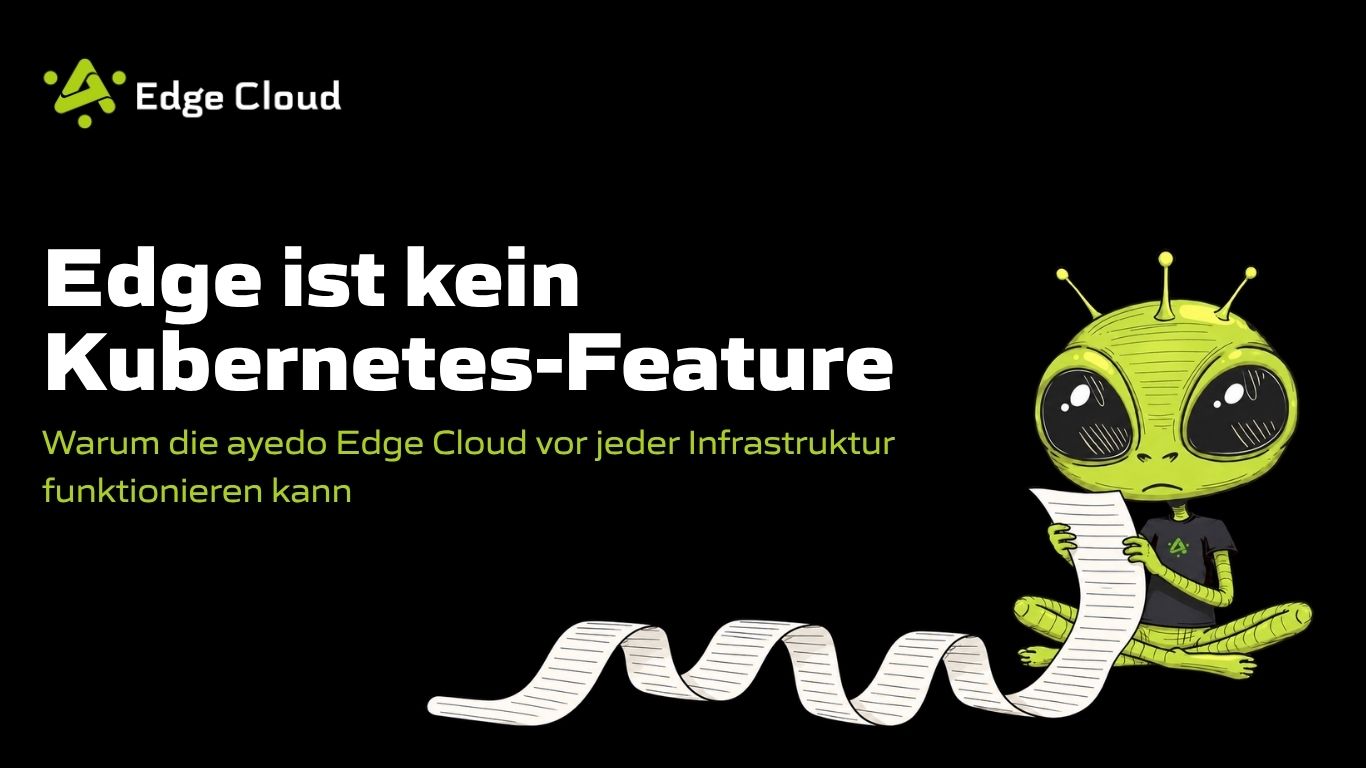
Kubernetes orchestrates workloads. An Edge Cloud controls how traffic reaches these workloads.
Provider dependencies in edge operations do not arise solely from the number of providers used. Critical are the technical couplings along DNS, IP addressing, routing, security, traffic distribution, and backend connectivity. A robust dependency analysis therefore evaluates switching costs, control points, and failover behavior. The ayedo Edge Cloud consolidates these layers into a provider-independent edge platform.

A portable edge architecture is not based on a single provider but on standardized network, protocol, and integration interfaces. DNS, TLS, HTTP, TCP/IP, and Proxy Protocol reduce proprietary lock-ins. However, they do not enable complete interchangeability: routing, security features, operational models, and migration remain architecture-specific tasks.

Exit capability in the cloud is not solely achieved through multiple compute providers. The key is which functions are operated independently before the workloads: public accessibility, TLS termination, protection, and routing. A provider-independent edge layer reduces migration effort but does not eliminate all dependencies. DNS, identities, data, secrets, and workload interfaces remain critical.

Digital sovereignty is not achieved solely by choosing a cloud application. The key factor is who controls the network, public access, routing, and protection mechanisms. A separate edge and compute architecture establishes clear areas of responsibility: The Edge Cloud manages external traffic, while backends can operate independently on their own or third-party compute platforms.

Having your own Autonomous System does not create complete independence but extends control over public traffic entry. With BGP, accessibility and routing can be independently managed. Combined with your own network infrastructure, Anycast, and active-active operation, digital sovereignty becomes a verifiable architectural decision.

A redundant edge does not eliminate a single point of failure if DNS, routing, TLS termination, WAF, or backends still depend on individual components or providers. High availability is achieved only through an end-to-end consideration of all dependencies. The ayedo Edge Cloud can reduce central edge risks but does not replace a redundant backend and operational architecture.

A Multi-PoP architecture does not automatically reduce failures. What matters is which components, lines, routing paths, and backends share the same failure domain. By analyzing failure boundaries instead of individual components, common dependencies can be identified earlier, allowing traffic, protection functions, and failover to be decoupled effectively.
The ayedo Edge Cloud is not a single add-on feature for Managed Kubernetes nor a front-end load balancer. It forms an independent architectural layer for public traffic: DNS, routing, protection, TLS, load balancing, and backend connectivity are centrally operated in front of various compute environments. This keeps applications and clusters interchangeable without redesigning public access.

Digital sovereignty in the public edge layer is not demonstrated by promises of origin, but by technical control points: Who controls routing, IP addressing, traffic distribution, protection functions, and operations? An own Autonomous System and network infrastructure provide the architectural foundation for this – but do not replace reliable operational processes.

Kubernetes clusters do not need to manage public traffic ingress, DDoS protection, or TLS termination themselves. A provider-independent edge layer separates these tasks from cluster operations. This allows clusters at ayedo, in your own data center, or with other providers to be connected via central routing, security, and failover functions.
DNS, TLS, and WAF serve different roles at the public entry point but act as a unified processing chain. Anycast DNS and Multi-Provider DNS direct requests to the edge, TLS termination makes encrypted traffic inspectable, and the Web Application Firewall evaluates HTTP/HTTPS requests. The key is not their individual functions but their interplay.

Anycast load balancing combines global reachability with targeted traffic distribution. Anycast determines which Edge PoP handles a request, while Layer 4 and Layer 7 load balancing direct the traffic there based on connections, protocols, and application characteristics. Only the interplay creates a resilient public access to applications and APIs.
Kubernetes compute and public application ingress do not have to reside with the same provider. An independent edge layer handles Anycast, DNS, load balancing, TLS, protection functions, and backend cloaking, while the cluster is operated with the chosen provider or in your own data center. A clear division of roles between edge, network, and compute is crucial.
A Kubernetes Ingress doesn't need to be directly tied to a cloud provider's load balancer. A central edge layer can connect multiple Kubernetes clusters through unified public IPs, TLS termination, protection functions, and health checks. The ayedo Edge Cloud enables this model for ayedo Managed Kubernetes, private clusters, and Kubernetes environments with other providers.
Automating Kubernetes Ingress involves more than just creating a load balancer via YAML. The key is the connection between declarative resources, edge configuration, and the actual backend. The ayedo Edge Cloud handles public entry, routing, protection, and health checks, while Kubernetes describes the desired publication.
DNS, Anycast reachability, and load balancing serve different purposes. A successful DNS resolution does not guarantee an accessible application; an accessible edge does not prove a healthy backend. For troubleshooting, the entire chain must be considered separately: DNS response, edge reachability, protocol processing, and backend distribution.
Provider-independent DNS is not achieved by swapping out a single provider but through an architecture with centralized control, clear accountability, and multiple authoritative DNS paths. External Zones can be managed consistently, while traffic entry, protection, and routing are organized independently of the DNS provider.
DNSSEC enhances the trustworthiness of authoritative DNS responses, but any discrepancy between DNS providers becomes operationally significant. In a multi-provider architecture, zone signing, DNSSEC keys, DS records, delegation, and failover must be planned as an integrated process. Redundant DNS operation is only resilient if all providers deliver verifiable and consistent responses.
Multi-Provider DNS distributes the responsibility for authoritative DNS zones across multiple independent providers. This increases DNS resilience but introduces additional requirements for delegation, zone consistency, changes, and monitoring. A central control does not need to replace all DNS servers but should primarily make responsibilities and configurations manageable.
Kubernetes DNS and public DNS serve different purposes: the cluster resolves internal services, while external zones define the public entry point for applications. A clear boundary of responsibility prevents misconfigurations, reduces dependencies on the cluster provider, and allows DNS, security, and traffic distribution to be consolidated on an edge platform.
Managing external DNS zones is a governance task, not just a technical routine. A central instance establishes clear responsibilities, controlled changes, and traceable zone boundaries. The ayedo Edge Cloud provides Anycast DNS and Multi-Provider-DNS for this purpose. DNS management and traffic distribution remain separate areas of responsibility.
Multi-Provider DNS distributes the authoritative DNS layer across multiple independent infrastructures, reducing the risk that a single failure interrupts name resolution and access to applications. However, it increases demands on zone synchronization, responsibilities, testing, and the evaluation of conflicting DNS states.
Kubernetes load balancing doesn't stop at the cluster's service object. For publicly accessible applications, IP distribution, TLS, routing, protection features, and backend selection must work together outside the cluster. A provider-independent edge integration separates these tasks from cluster operations and supports L4 and L7 scenarios for services, APIs, and ingress architectures.

Backend pools are not merely a technical grouping of target systems; they are a central element of load balancing architecture. A clear structure based on application, API, environment, and operational responsibility enhances routing, isolation, and troubleshooting. The ayedo Edge Cloud can integrate provider-independent backends and centrally distribute traffic to appropriate target systems.
Kubernetes load balancing should be considered on three separate levels: the public entry at the edge, forwarding into the cluster network, and distribution to the actual workloads. L4 and L7 serve different purposes. The ayedo Edge Cloud enables this separation independently of the provider – with ayedo Managed Kubernetes as well as with externally operated clusters.

In the dynamic e-commerce business, the client portfolio of agencies and digital service providers often grows faster than the underlying hosting infrastructure. Over the years, established single-server setups, historically grown configuration differences, and fragmented hosting providers become massive stability and security risks beyond a certain operational size. When marketing campaigns, TV appearances, or seasonal events like Black Friday generate sudden traffic spikes, monolithic single installations reach their physical limits—with fatal consequences for availability commitments and business relationships.
In highly regulated industries such as banking and insurance, modern SaaS business models rarely fail due to application logic, but rather due to restrictive hosting requirements of enterprise customers. While agile fintechs aim to scale their platforms in standardized cloud environments, conservative institutions and public entities demand on-premises operations behind the corporate firewall due to data classification and compliance reasons. For software manufacturers, this discrepancy traditionally leads to costly codebase fragmentation and significant friction losses in platform engineering.