How peering, routing, and DDoS protection keep traffic flowing
Data on the internet often takes a longer route than you might expect. Traffic from Frankfurt, for example, can pass through Amsterdam before reaching Hamburg. That can multiply latency, and extra bandwidth cannot shorten the route. Direct peering at local internet exchanges and location-aware routing can help. The level66.network point of presence for the ayedo Edge Cloud at Digital Realty FRA11 in Frankfurt shows how this works.
Jan Gilla, network architect at level66.network
Why more bandwidth does not always improve performance
When an application responds slowly, the first instinct is often to ask the network operator for more bandwidth. That helps when a link is at capacity. Latency also depends on the physical distance a packet travels and the routers it passes through. Take Frankfurt and Hamburg. Some operators send traffic directly through Germany. Others route it through Amsterdam, sometimes without realizing it. The extra distance increases latency even if there is ample bandwidth along the way.
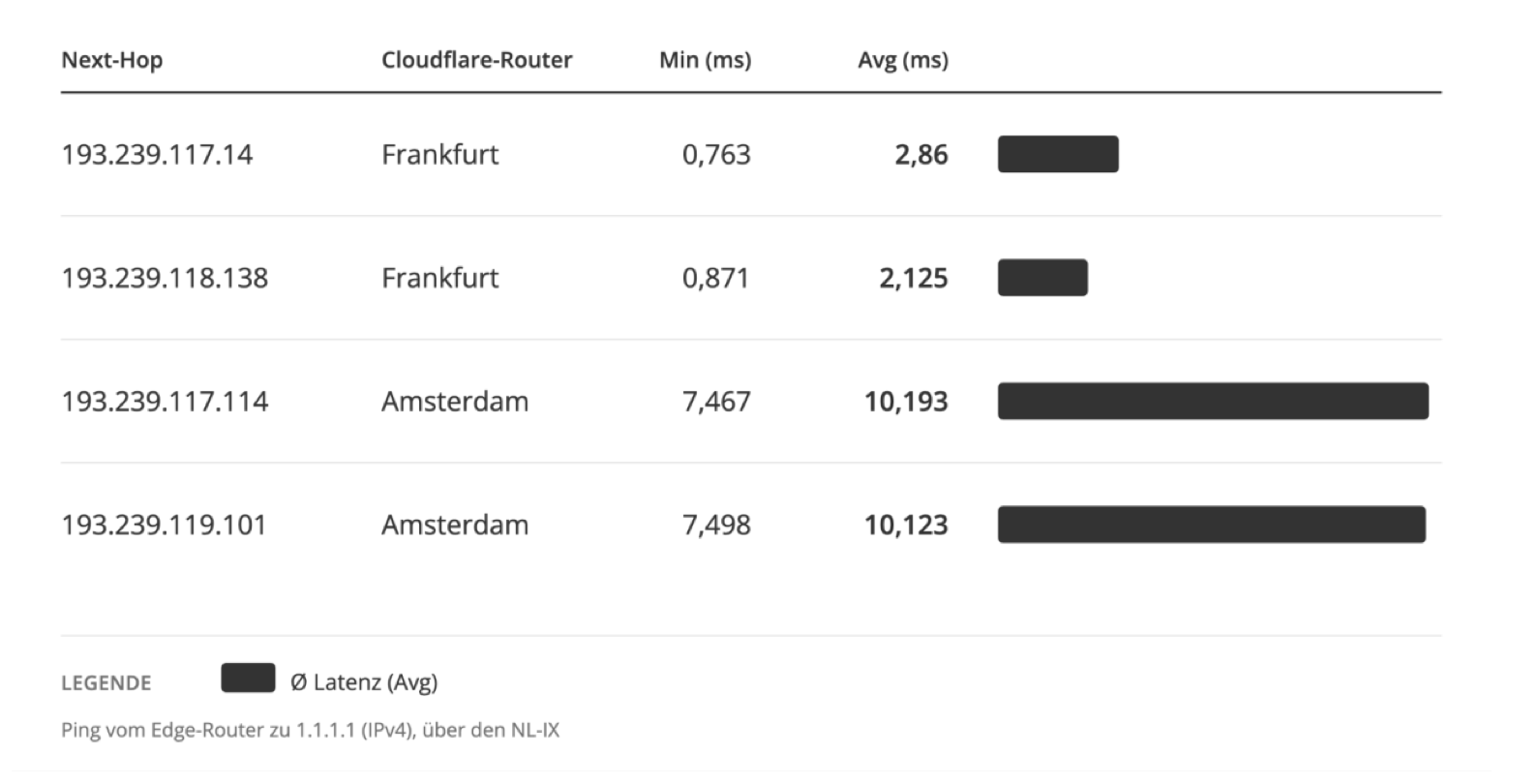
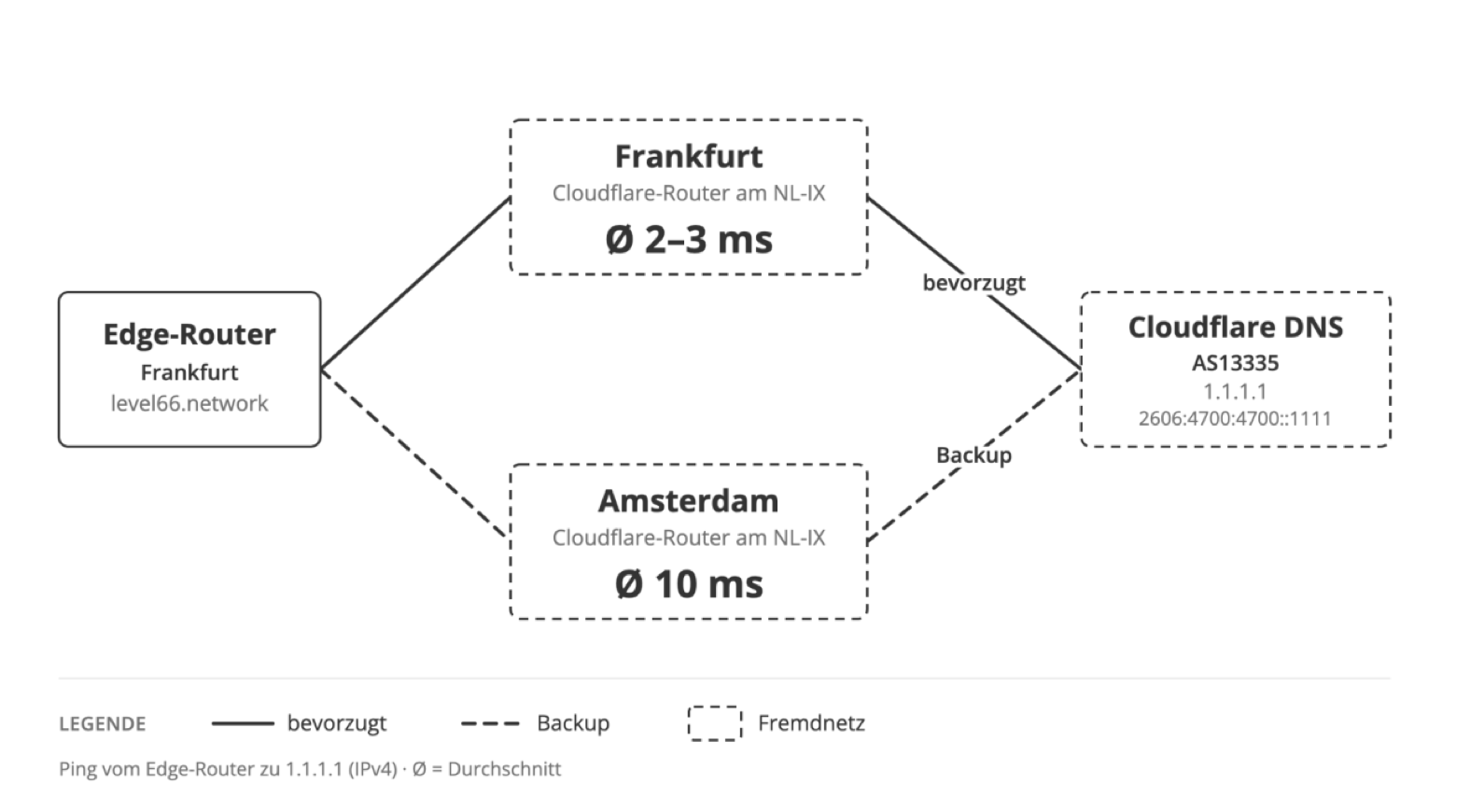
We can see this in measurements to Cloudflare’s DNS service (1.1.1.1, AS13335), which we reach via multiple paths at the NL-IX internet exchange. We ran pings from our edge router in Frankfurt. The slower route goes through Amsterdam.
Peering speeds up data transfer
Peering is one of the most effective ways to speed up data transfer. Two network operators connect directly and exchange traffic without using another operator’s infrastructure. With transit, an operator buys internet reachability from an upstream provider and has limited control over the path the packets take through that network.
Operators peer at internet exchange points (IXPs). Networks connect their routers to a shared platform and exchange traffic directly. Our infrastructure is located in the carrier-neutral Digital Realty FRA11 data center in Frankfurt. We peer at several IXPs there and connect directly to most hosting providers. According to bgp.tools, our network was among the top 55 in Germany by known peers and the top 25 by AS cone as of October 14, 2026.
For the Edge Cloud, this means short paths to the networks where users connect and to the data centers where services run.
Optimizing routing for the location
Many IXP operators offer remote peering. A network might operate a router in Hamburg or Amsterdam and still exchange traffic with networks in Frankfurt. That is attractive to the IXP and useful for some networks. It can also add latency. A route learned at an IXP gives you limited visibility into whether the network behind it is in Frankfurt or somewhere else.
At the IXP, we give preference to routes from networks at the same location. We lower the preference of other routes to avoid sending traffic to Amsterdam and back. We also announce our own networks only at the local site. BGP communities let us tag routes with location information so we can apply these preferences. Configuring the infrastructure we already have is often enough.
The most common mistakes are:
- Buying more bandwidth when the route is the problem.
- Treating all routes at the IXP equally without considering peer location.
- Announcing your routes everywhere and causing detours on the return path.
How DDoS protection clears congested links
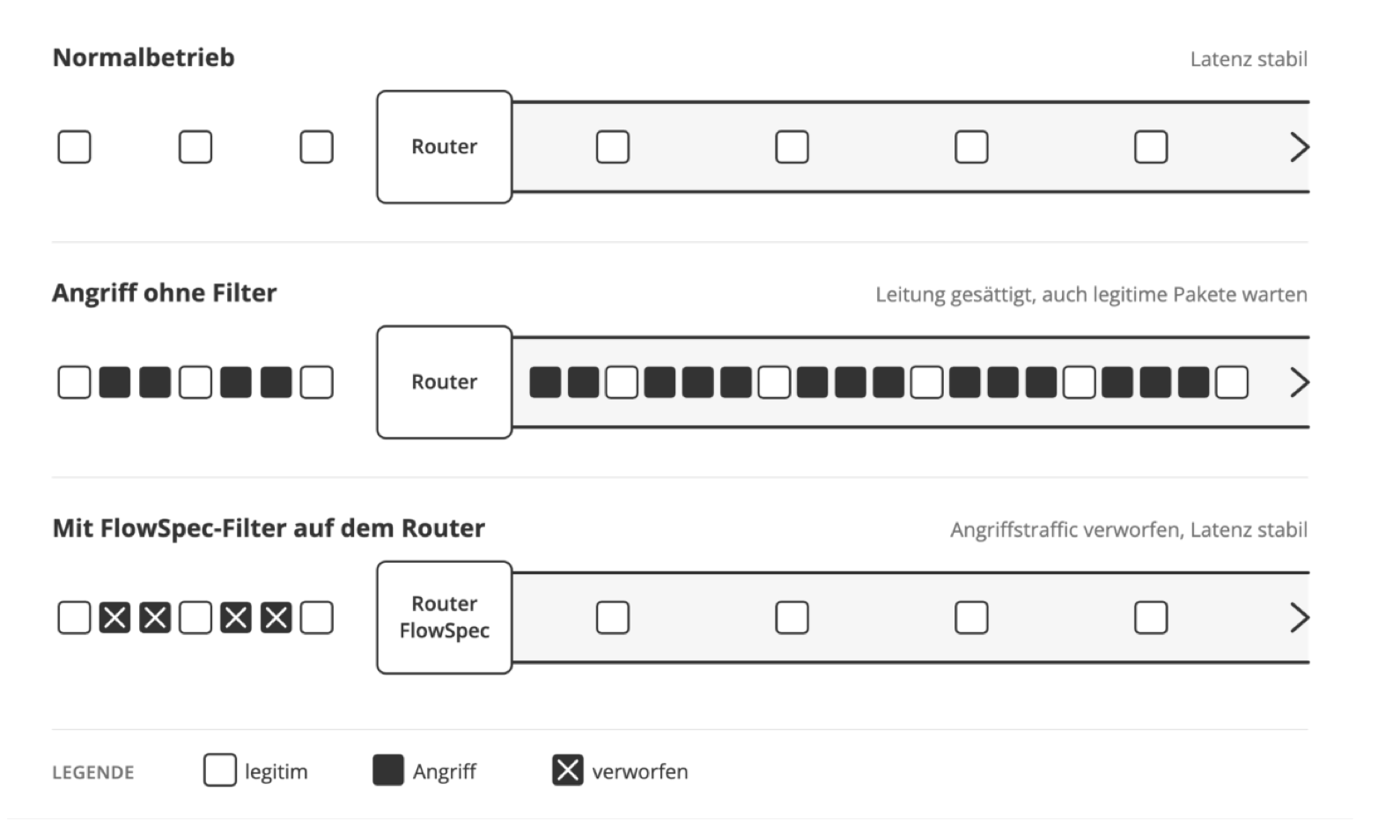
A full link can also increase latency. When a DDoS attack saturates a connection, packets queue at the bottleneck and legitimate traffic has to wait. A pipe can only carry as much as its cross-section allows.
One way to clear the link is to use blackholing to drop all traffic to the address under attack. It is a simple emergency measure that also makes the service unavailable to legitimate users. That achieves the attacker’s objective. We developed a way to filter out the attack traffic and let legitimate packets through. We do this directly on our routers. Our tool, flowwler, detects the attack pattern and distributes matching filter rules via BGP FlowSpec. The routers drop the malicious packets before the link becomes congested. Latency stays stable for other traffic.
Keep Traffic Local
Peering, routing, and DDoS protection all benefit from exchanging internet traffic close to its destination. That helps avoid sending packets across the country or through Europe.
We are working on this in several ways. Alongside our location-based routing policy, we built a small tool that receives routes from the router, identifies the available paths to a destination, measures them regularly, and recommends the path with the lowest latency. A person reviews the recommendation before the routing change is applied. With MAINPORT, we apply the same approach to Frankfurt’s data center ecosystem. Networks can connect directly through a shared connectivity platform instead of booking multiple individual links. The name refers to Frankfurt am Main and the focus on keeping traffic local. We designed flowwler to protect our own network and to be usable by other carriers and service providers.
“Keep Traffic Local” is a principle in the networking community. I would like to see us move further in that direction and rely less on a handful of large providers.
About the author: Jan Gilla is a network architect and runs level66.network, with infrastructure at the Digital Realty FRA11 data center in Frankfurt. He focuses on carrier and data center networks, peering, and DDoS protection.