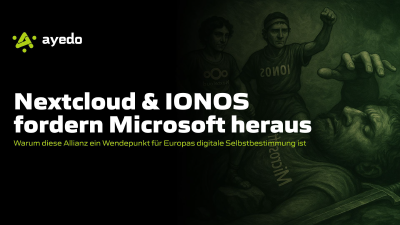
Nextcloud & IONOS Challenge Microsoft
Why this alliance is a turning point for Europe’s digital self-determination The headline may …
25.06.2025
The digitization of healthcare promises enormous advancements: from telemedicine support to AI-assisted diagnostics and electronic patient records. However, with increased connectivity comes a fundamental concern: who has access to the most sensitive information a person possesses in case of doubt?
For hospitals, pharmaceutical companies, and MedTech startups, choosing IT infrastructure is no longer just a technical decision. It is an ethical and legal fundamental decision. Opting for traditional US-based public cloud providers places one in a tension between technological convenience and the risk of data leakage.
In Europe, the GDPR enforces the world’s strictest data protection rules, especially for health data (Art. 9 GDPR). In contrast, the US Cloud Act requires US companies to grant authorities access to stored data—even if these are on servers within the EU.
For healthcare stakeholders, this means:
Digital sovereignty in healthcare doesn’t mean retreating to a dusty server room in the basement. It means combining the agility of the cloud with the security of national and European legal standards.
A sovereign infrastructure utilizes modern orchestration tools like Kubernetes to operate applications with high efficiency. The key difference: control over data pathways and encryption remains entirely in European hands.
By consistently using open-source technologies, medical applications remain portable. A hospital or pharmaceutical company can move its workloads between different sovereign providers at any time. No longer are they hostage to proprietary infrastructure.
Whether it’s research data for new drugs or the medical history of millions of insured individuals—these data are the industry’s most valuable asset. A sovereign platform provides dedicated environments where physical or logical separation from other users is guaranteed.
In the healthcare sector, trust is the foundation of every business model. Those who act technologically sovereign not only protect patient privacy but also secure their long-term ability to operate against global platform giants. Sovereignty is not an obstacle to innovation but its safest foundation.
Is choosing a server location in Germany with a US provider not sufficient? Legally, often not. The US Cloud Act allows US authorities to demand data disclosure if the provider is headquartered in the US, regardless of the server’s physical location. True sovereignty is only offered by a provider under purely European jurisdiction.
Is sovereign IT infrastructure as powerful as the major public clouds? Yes. By using standardized Cloud-Native technologies, sovereign platforms achieve the same scalability and performance. The difference lies not in CPU performance, but in the legal and strategic framework.
What happens to patient data when switching providers? Thanks to open standards like Kubernetes, switching (“exit strategy”) is much easier. Data and applications are not tied to vendor-specific services and can be migrated without months of reprogramming.
How does sovereignty support the certification of medical products? For approval (e.g., according to DiGAV or MDR), proof of patient data protection is essential. A sovereign infrastructure simplifies this process, as many compliance questions regarding third-country transfers are eliminated from the outset.
Can existing on-premise systems be integrated? Absolutely. Sovereign architectures are ideal for hybrid scenarios. Sensitive data can be processed locally, while scalable computing power is added from a sovereign cloud.
Why this alliance is a turning point for Europe’s digital self-determination The headline may …
Introduction Many cloud strategies in European companies are based on an assumption long considered …
Why Control is More Important than Server Location Introduction Cloud computing is far more than …