Weekly Backlog Week 48/2025
Editorial This week, Europe once again loudly proclaimed ‘Digital Sovereignty!’—only to …
19.11.2025
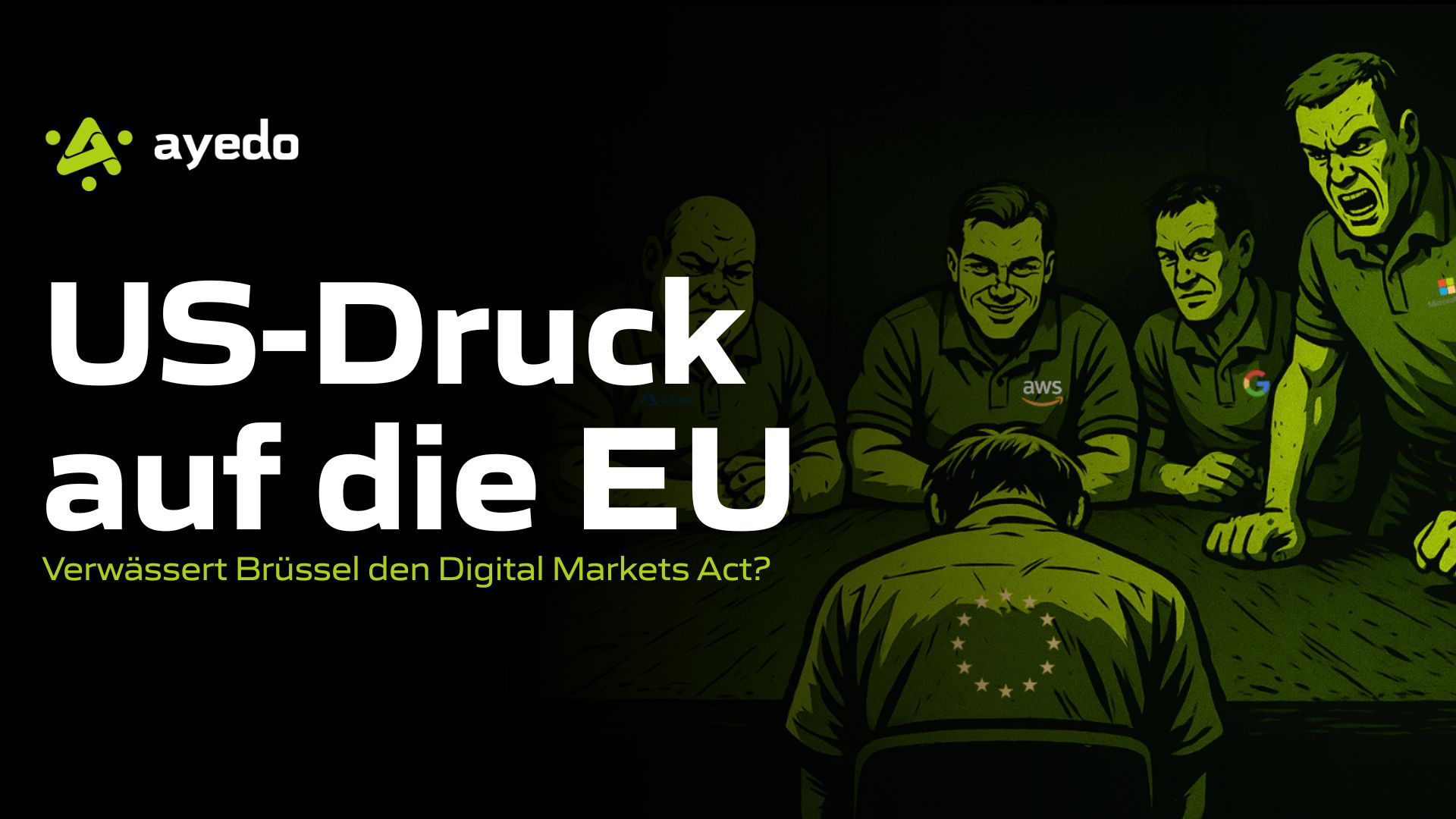
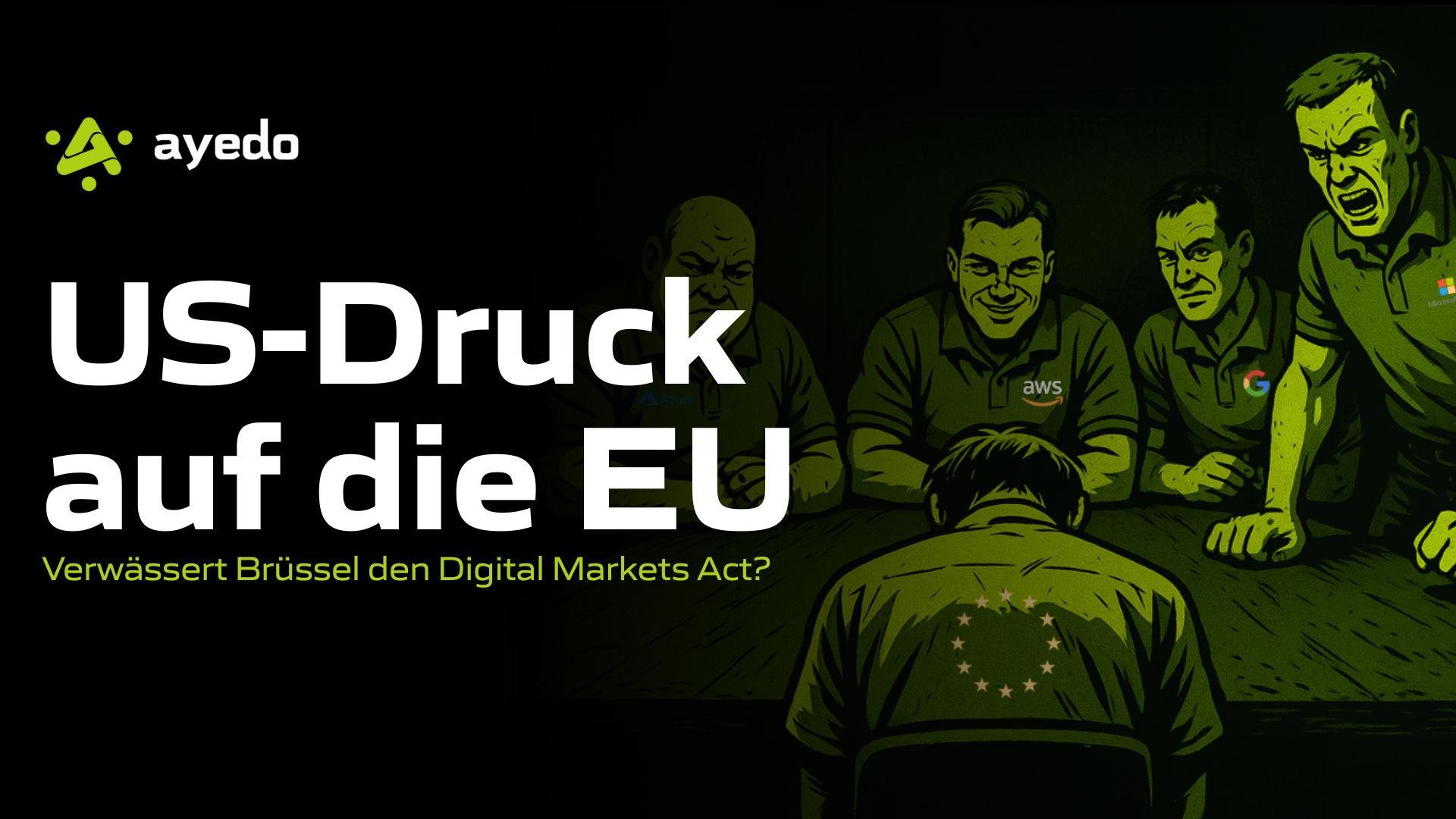
The European Union celebrated itself as a pioneer in regulating digital platforms. With the Digital Markets Act (DMA), it aimed to make a statement: against dominant tech corporations, for more competition, data control, and transparency. The DMA came into force in March 2024 – but barely a year later, this very European regulation is apparently up for debate. And not from Brussels itself, but from Washington.
As reported by Süddeutsche Zeitung and Handelsblatt, the EU Commission is negotiating a new transatlantic trade agreement with the USA, discussing not only tariffs but also the implementation of the DMA. According to consistent sources, there are considerations to apply the rules more “flexibly” – even a joint committee is being discussed, where the USA could influence the application of European laws.
This would be nothing short of a precedent. A third country allowed to co-determine the concrete interpretation of a European law? And with a law that specifically targets US companies like Apple, Meta, Google, Amazon, and Microsoft?
Of course, there is already a dialogue between EU institutions and the affected corporations – for example, within the framework of the so-called “Stakeholder Workshops” provided for by the DMA. But these are about transparency and technical feasibility, not political influence.
However, when rumors circulate that lobbyists in Brussels are once again more successful than democratic control, a fundamental question arises: Is Europe willing to defend its own rules against economic pressure?
The Financial Times puts it succinctly: The DMA is the “world’s most effective tool to curb the monopolistic solo efforts of US Big Tech.” And that is precisely why it is branded as “anti-American” by US corporations and their lobby groups. This rhetoric is catching on – apparently even with parts of the EU Commission.
Several start-up associations and medium-sized tech companies have now spoken out in open letters – including to Chancellor Friedrich Merz and the Commission in Brussels. Their demand: No special regulations. No retreat. No deals with platform monopolists.
Because from their perspective, the DMA is not just a law – it is a promise. A promise that market access, data portability, interoperability, and fair conditions not only exist in principle but are enforced.
If this promise is broken, not only political credibility losses are at stake. There are also hard economic consequences: The dominance of a few US platforms in the adtech market leads to 75% of digital advertising budgets in Germany alone flowing to Google, Meta, and Amazon – the rest of the ecosystem is left behind.
The DMA was supposed to change that. If it is diluted, not much will remain.
Officially, the Commission remains calm. There are no plans to change or relativize the DMA. Executive Vice President Henna Virkkunen also emphasized to the Guardian in the spring that they would not yield to pressure from Washington.
But how credible is that when new “cooperation formats” are being discussed in parallel, in which precisely those corporations are supposed to have a say whose business models are being regulated?
Even if no formal changes are decided, the political signal is fatal: If a law that was once presented with great pathos as a bulwark against digital monopolies becomes negotiable behind closed doors, then Europe has lost its regulatory backbone.
Big Tech is not a European partner – it is a global power factor. These corporations do not act in the spirit of fair competition, but as economic-political actors with geopolitical weight.
They do not play along – they dominate. And they have a clear interest in negotiating, delaying, or incorporating rules that affect them into their own system.
If Europe bows to this game instead of setting its own standards, it not only loses control over its markets but also over its digital sovereignty.
European digital policy is at a turning point. It is no longer enough to issue regulations – they must also be defended. Against lobbying pressure. Against economic threats. Against the narrative that regulation is anti-innovation.
Because the opposite is true: Without fair conditions, there is no innovation, only monopoly management.
The EU must make it clear: The DMA is non-negotiable. Neither in Brussels nor in Washington.
The dependence on US technology is also evident with the upcoming end of support for Windows 10, which poses similar challenges for German companies. And that is precisely why we are currently experiencing the digital sellout of Europe, which can only be countered by consistent regulation and European alternatives.
Editorial This week, Europe once again loudly proclaimed ‘Digital Sovereignty!’—only to …
Cloud Brokering for True Sovereignty The discussion about digital sovereignty in Europe is old, but …
The European AI Act, the first comprehensive regulation for artificial intelligence worldwide, was …