What Does "Digital Sovereignty" Actually Mean – In Concrete Terms?
Digital sovereignty refers to an organization’s ability to manage its digital systems, data …
11.06.2025
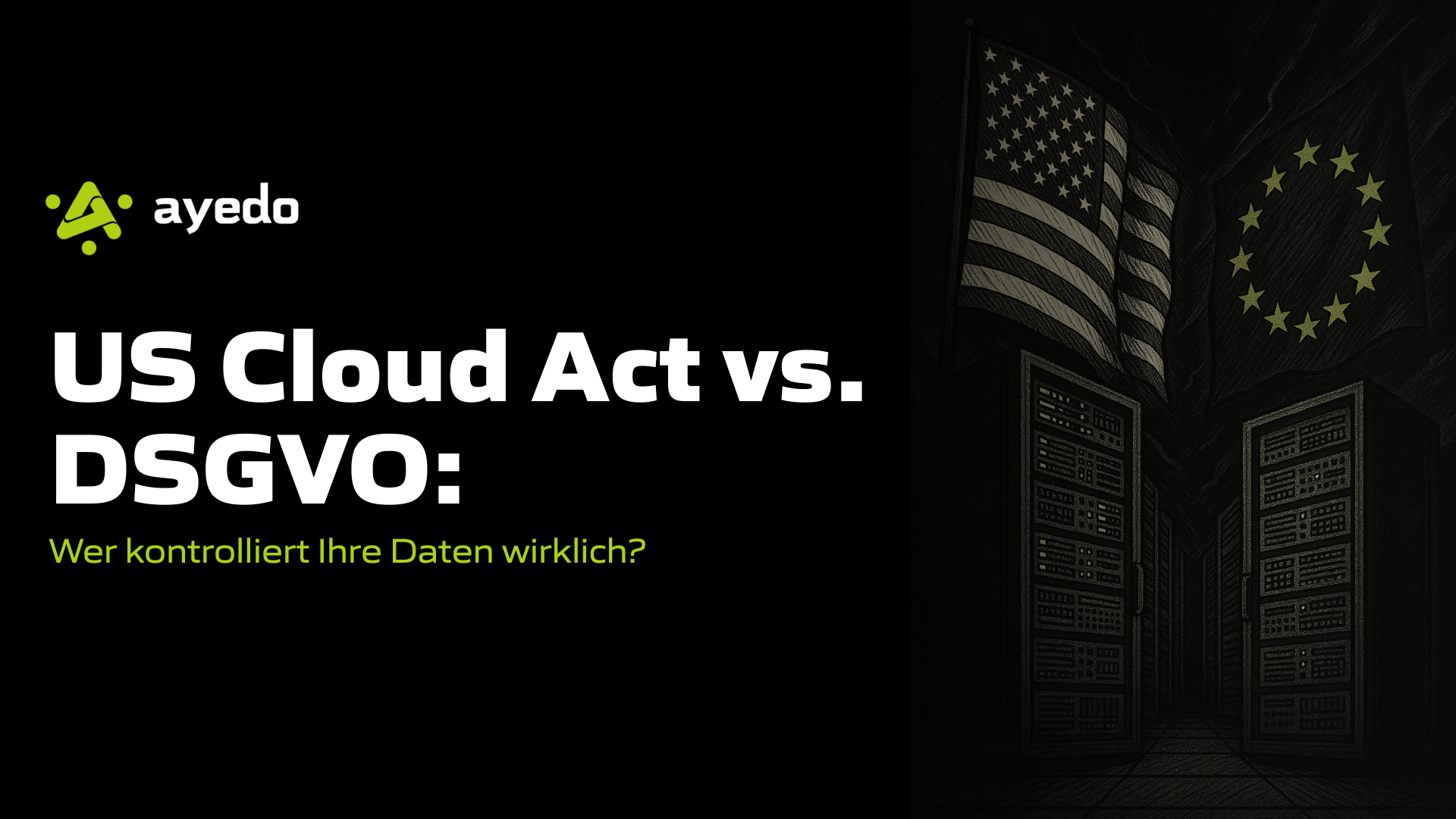

The CLOUD Act allows US authorities to access European data, conflicting with the GDPR. Learn how companies can protect themselves technically and legally.
In March 2018, the US government passed the CLOUD Act (Clarifying Lawful Overseas Use of Data Act). What initially seems like technocratic legislation is, in reality, a geopolitical reach into your corporate data—even if stored on European servers. The key factor is not the location of the servers but who controls them.
According to the CLOUD Act, US authorities can access data if it is owned or controlled by a US company. This completely overturns the argument for local storage. It no longer matters whether your data is in Frankfurt, Dublin, or Paris—Microsoft, Google & Co. must hand it over upon request.
Here begins the legal dilemma. The GDPR, specifically Article 48, stipulates that data access by foreign authorities must occur within the framework of international agreements. Such requests must go through national authorities—not directly to the cloud provider. However, the CLOUD Act allows exactly that.
Companies that transmit personal data without this legal basis potentially commit a GDPR violation, punishable by fines of up to 20 million euros or 4% of annual turnover. Whether the bilateral agreements envisaged in the CLOUD Act will be considered “international agreements” under the GDPR is unclear—a legal risk with an open outcome.
Microsoft responded with its own model: “Office 365 Germany” was operated with Deutsche Telekom as a data trustee. Advantage: The data was not under Microsoft’s direct control. However, the service has since been discontinued. Other providers consistently rely on a model that creates genuine technical barriers—operator-secure cloud services.
These services operate on the principle: What we can’t see, we can’t hand over. Through complete hardware isolation and end-to-end encryption, providers have no access to customer data—not even under court order. Access by US or other authorities? Technically impossible.
Those using cloud services and wishing to remain GDPR-compliant should check the following criteria:
| Criterion | Recommendation |
|---|---|
| Provider’s headquarters | Within the EU, ideally Germany |
| Control over infrastructure | No involvement or control by US companies |
| Technical protection concept | Confidential Computing, Zero Access Architecture |
| Certificates & standards | TCDP, ISO/IEC 27001, BSI C5, etc. |
Certifications like the Trusted Cloud Data Protection Profile (TCDP) provide legal guidance and enhance compliance security. They help companies identify responsible providers who not only advertise compliance with GDPR requirements but also implement them technically and organizationally.
At ayedo, we do not believe in compromises when it comes to data protection, IT security, and digital sovereignty. Our solutions combine European technology with maximum transparency and compliance. For those who want to use the cloud not only securely but also strategically wisely.
With ayedo, you build your digital infrastructure on a foundation of trust, control, and independence. This way, digitalization does not become a security gap—but a strength.
Digital sovereignty refers to an organization’s ability to manage its digital systems, data …

In most discussions about the Cloud Act, the focus is solely on data location. Data center in …
The US Cloud Act allows US authorities to access European servers—a clear conflict with the GDPR. …