End of Support for Windows 10: Why Now is the Right Time to Break Away from Hyperscalers
On October 14, 2025, regular support for Windows 10 will end. What initially appears to many IT …
10.07.2025
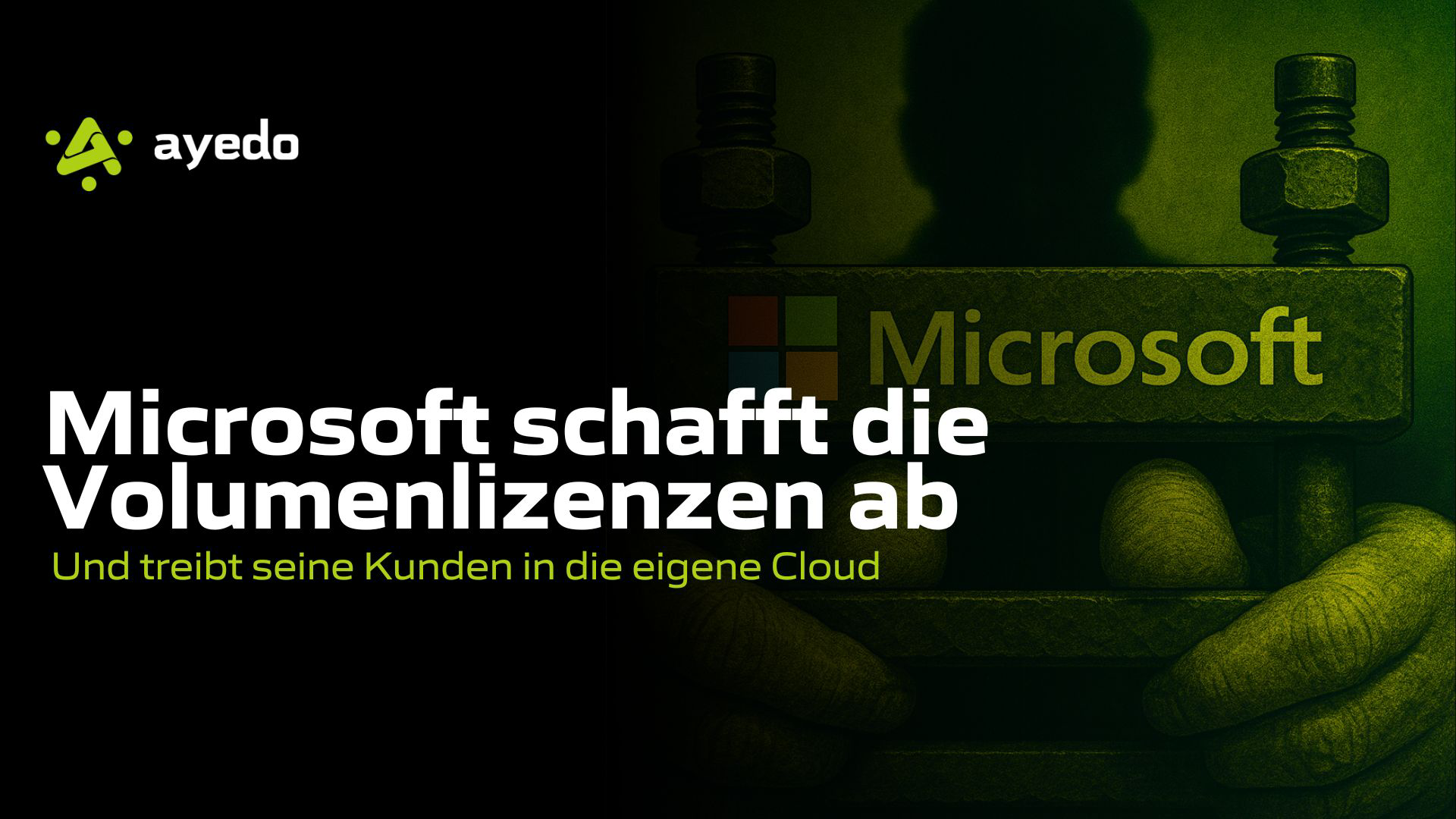
Starting November 1, 2025, Microsoft will eliminate traditional volume licenses. Specifically affected are the major licensing models Enterprise Agreement (EA) and Microsoft Products and Services Agreement (MPSA). Previously, companies could receive discounts between 6 and 12 percent off the list price depending on the volume purchased. This will soon end. From November, all customers will fall into price level A – and will pay the full list price as it appears on the Microsoft website.
Existing contracts will continue, but with each renewal or purchase of new services, the price increase will take effect. All cloud services are affected, from Microsoft 365 and Dynamics 365 to Windows 365 and the security and compliance products. Only the US government and education price lists are exempt – a telling detail that once again shows where Microsoft’s priorities lie.
Officially, Microsoft talks about “simplifying pricing structures” and allowing partners to “focus more on customers’ business needs.” In reality, it’s another step in a long-standing strategy: to drive customers consistently into their own cloud.
On-premises software is being made increasingly unattractive, whether through price increases, licensing hurdles, or artificial restrictions. Anyone wanting to use Microsoft products inevitably ends up in the cloud – where Redmond dictates the terms.
The elimination of volume licenses is not an isolated case but part of a pattern: Microsoft uses its dominant market position to gradually push customers into a model that serves the corporation alone. Pricing, contract structures, technical limitations – all aim to portray their cloud as without alternative.
And it works. A large portion of European companies is already reliant on Microsoft. This not only costs us economic flexibility but also a significant part of our digital sovereignty.
Europe can no longer stand by. We need real investments in open-source solutions, promotion of platform-independent software development, and strategic alliances with European cloud providers. What digital sovereignty really means and why it is crucial for survival is becoming clear in such moments. Otherwise, we pay the price twice: financially – through rising costs – and politically – through the loss of control over our own data.
On October 14, 2025, regular support for Windows 10 will end. What initially appears to many IT …

Cloud infrastructure has its justification. Scalability, automation, and globalization of IT …

Weekly Backlog #47 — Digital Sovereignty? I have a few questions… Editorial Welcome to a week where …