Compatibility of Container Images: A Key to Reliability in Cloud Environments
In industries where systems must operate with utmost reliability and stringent performance …
28.06.2025


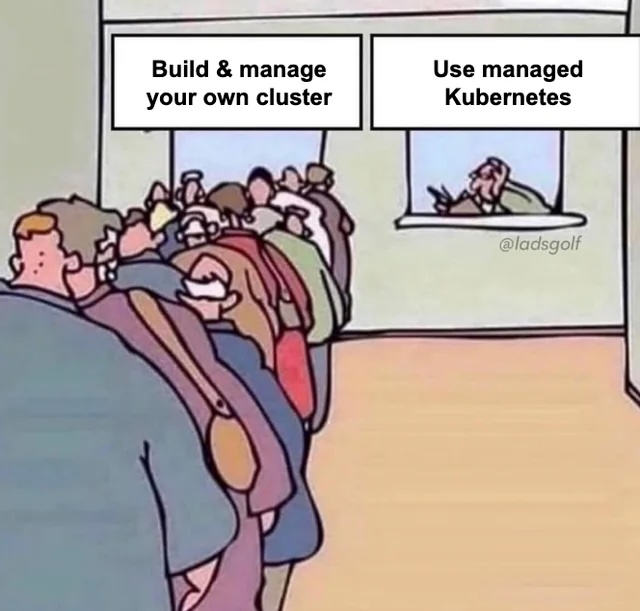
In few other technology sectors is there such passionate debate about self-management versus outsourcing as with Kubernetes.
The technology is young, powerful, standardized – and at the same time, relentlessly complex. It symbolizes progress, modernity, and sovereignty.
But a closer look reveals: Kubernetes is not the new “vSphere” that you install once and then “just let it run.” It is a living, rapidly evolving platform that resembles a software ecosystem more than an infrastructure.
Especially in Germany, we observe a recurring pattern: a deeply rooted “Not Invented Here” syndrome. It manifests in the belief that one is only sovereign if things are built, operated, and controlled internally – even if it regularly pushes the organization to its limits.
This cultural reflex has done much good in the German industry. It has shaped engineering skills and a sense of quality. But in the cloud world, where speed and automation are more important than perfection and control, this reflex becomes a brake block.
Sovereignty is often mistakenly equated with autonomy in many organizations. However, autonomy is not a sign of strength, but often of isolation. Sovereign is the one who can decide – not the one who does everything themselves.
Kubernetes is the best example of this. Many companies start with an ambitious goal: “We want to become cloud-native. We containerize everything and operate Kubernetes ourselves. Of course, on-premise.”
The idea sounds reasonable. They want to maintain control, meet security requirements, and avoid dependency on a hyperscaler. But in practice, many underestimate what they are actually taking on.
Kubernetes is not a product you buy and install. It is a framework that must be understood, maintained, and continuously developed.
The effort for this is often considered a minor matter – until the first production cluster hangs, the API servers are unreachable, or an upgrade fails.
As consultants in the field of cloud-native software, Kubernetes operations, and digital sovereignty, we at ayedo encounter the same pattern almost daily: Companies want to modernize, automate, and innovate – but they start with the assumption that they can operate Kubernetes like an appliance.
The reality is more complex. Kubernetes is a distributed Linux control plane, not a monolithic server service. It is highly dynamic, highly sensitive, and requires deep technical understanding in several disciplines: Linux, networks, certificates, security, storage, APIs, GitOps, observability, and not least software engineering. Many teams only realize this after investing months in their own solution.
Kubernetes evolves at a breathtaking pace. Approximately every four months, a new version is released. After a year, older releases are considered “deprecated.”
This sounds like healthy development but poses an enormous challenge in operations – especially in regulated or security-critical environments.
Those who operate on-premise must integrate, test, validate, and roll out these updates themselves. This affects not only the cluster but also all dependent components: Container runtime, CNI, CSI, ingress controller, monitoring, logging, backup, security policies.
In managed environments, this happens automatically. On-premise, however, each upgrade becomes a mini-project.
Kubernetes is not a GUI product. At its core, it is an operating system for clusters – and thus a system deeply rooted in Linux.
Those accustomed to click-ops or coming from a purely Windows world face a paradigm shift here.
Understanding namespaces, kernel parameters, IP tables, overlay networks, or container scheduling is not “nice to have” but a prerequisite.
A misconfigured parameter, an expired certificate, or a non-functioning network plugin can render the entire cluster unusable.
This technical depth is both the greatest strength and weakness of Kubernetes. It allows for extreme flexibility – but requires expertise that is simply not available in many organizations.
A common misconception is that Kubernetes consists only of YAML files. In truth, Kubernetes is an ecosystem for “Infrastructure as Code.” This means:
You work with Git, CLI tooling, GPG, SSH, proxies, scripting languages, APIs. You write templates, pipelines, and automations. You think in declarative states, not in manual actions. For traditional system administrators, this is a cultural shift. The transition from “I execute a command” to “I describe what should happen” requires a rethinking that does not happen overnight.
Operating a cluster is thus less an infrastructure topic – and more a software topic.
In traditional IT environments, operations consisted of a series of concrete actions: Install, configure, restart.
Kubernetes works differently. Here, you describe the “desired state” – the desired state of a system – and leave it to the control plane to establish this state.
This sounds elegant but is a radical paradigm shift. Because what happens if the desired state cannot be achieved? Or if multiple operators are working on different states simultaneously?
These questions are complex and often lead to error patterns that are difficult to trace.
Kubernetes was developed for scaling. But scaling is not an end in itself.
Many teams coming from the traditional server world underestimate the internal dependencies that come with distributed systems. A cluster consists of many moving parts whose interaction is sensitive.
If a service hangs, the cause is rarely “too little CPU” or “too little RAM,” but often network problems, timeouts, pod states, resource limits, or faulty deployments.
Scaling can mask symptoms but cannot heal architectural errors.
Many companies hesitate to use managed offerings because they fear losing control. But in truth, the opposite is the case.
A good managed service does not take control – it takes the burden. It ensures that the infrastructure runs, updates, remains secure, and is observable. Control over the application, the data, the configuration remains with the customer.
This is exactly the principle we work by at ayedo. In our projects, we repeatedly experience that after initial skepticism, a pragmatic reality sets in:
About 80% of our consulting clients opt for a hybrid approach in the long term.
They retain control over software development and business applications – we take over the operation of the clusters, platform components, and 24/7 availability.
This model combines both: autonomy and security. It allows companies to use their own infrastructure (whether sovereign, certified, or self-managed) but to outsource the complexity of cluster operations.
This creates true sovereignty – both technically and organizationally.
Kubernetes is not a one-time cost factor. It is an ongoing project – with upgrades, monitoring, security, compliance, training, and incident response.
Many companies underestimate how expensive “self-management” becomes in the long run. The costs hide in personnel commitment, knowledge building, outages, response times, and inefficient resource use.
Managed offerings are more expensive at first glance – but more transparent at second glance.
They scale with usage, not with personnel. And they give teams the space to focus on their actual tasks: development, innovation, value creation.
The question “Make or Buy?” is fundamentally not a technical one but a cultural one. It determines how an organization handles responsibility.
Those who build everything themselves also bear everything themselves. Those who delegate gain time, focus, and availability.
Sovereignty means having the choice – and making it consciously. For many companies, the smartest decision is therefore not “do everything yourself” but “do the right things yourself.”
With ayedo, we support exactly this path: We empower teams to understand Kubernetes and cloud-native architectures, but we relieve them of the burden of daily operational responsibility.
The result is the best of both worlds – technological autonomy without operational ballast.
Because modern IT does not need heroes who fix clusters at night. It needs systems that just run.
In industries where systems must operate with utmost reliability and stringent performance …

Cloud-Native Without Cloud Lock-in: Why Portability is the New Security When discussing modern IT …

Editorial Christmas Eve is traditionally the moment when you convince yourself that nothing …