Kubernetes as a Bridge Between IT and OT: Intelligently Processing Real-Time Data from Machines
The Gap Between Shopfloor and Enterprise IT In more and more companies, IT and OT (Operational …
01.06.2025
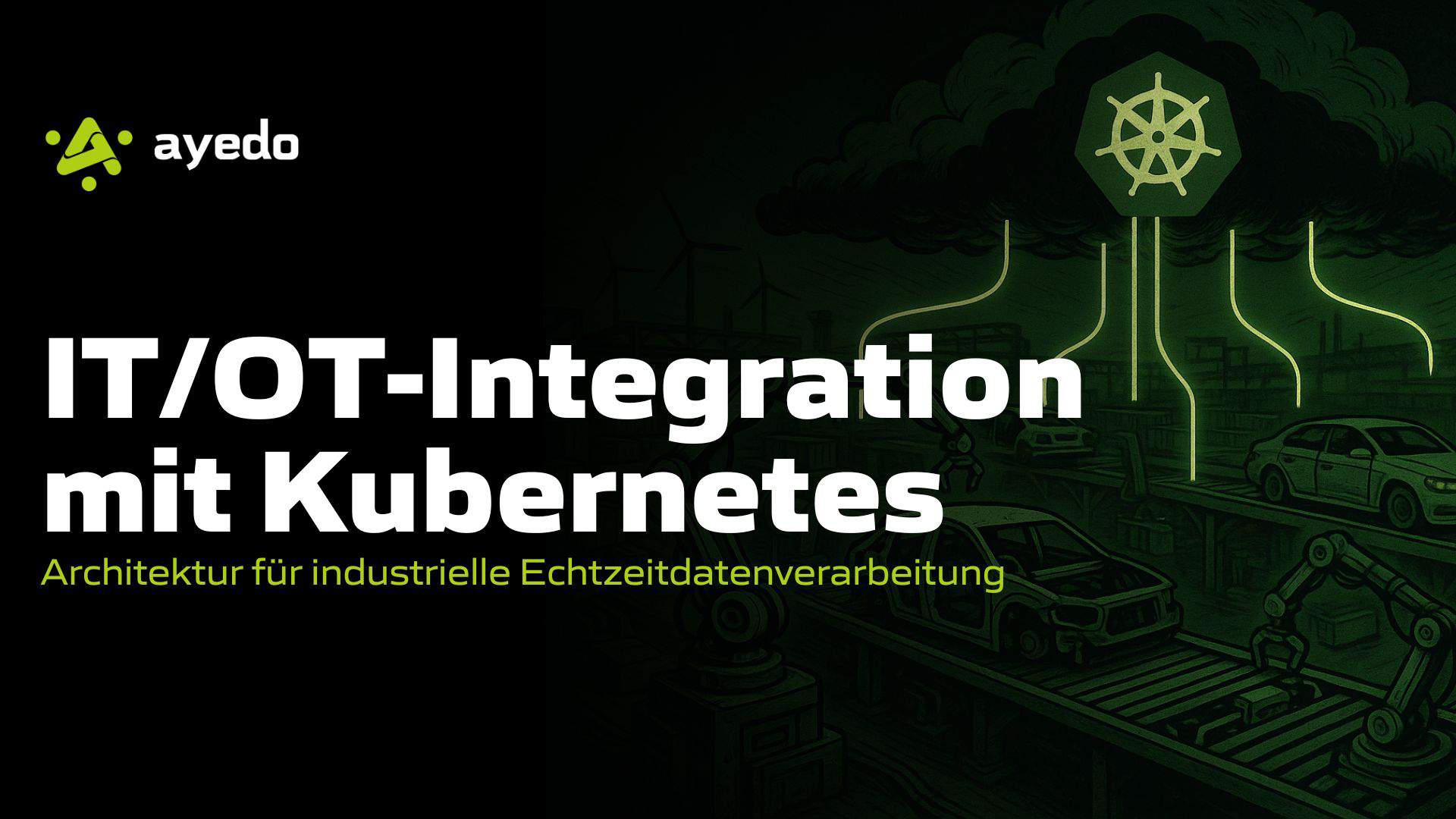
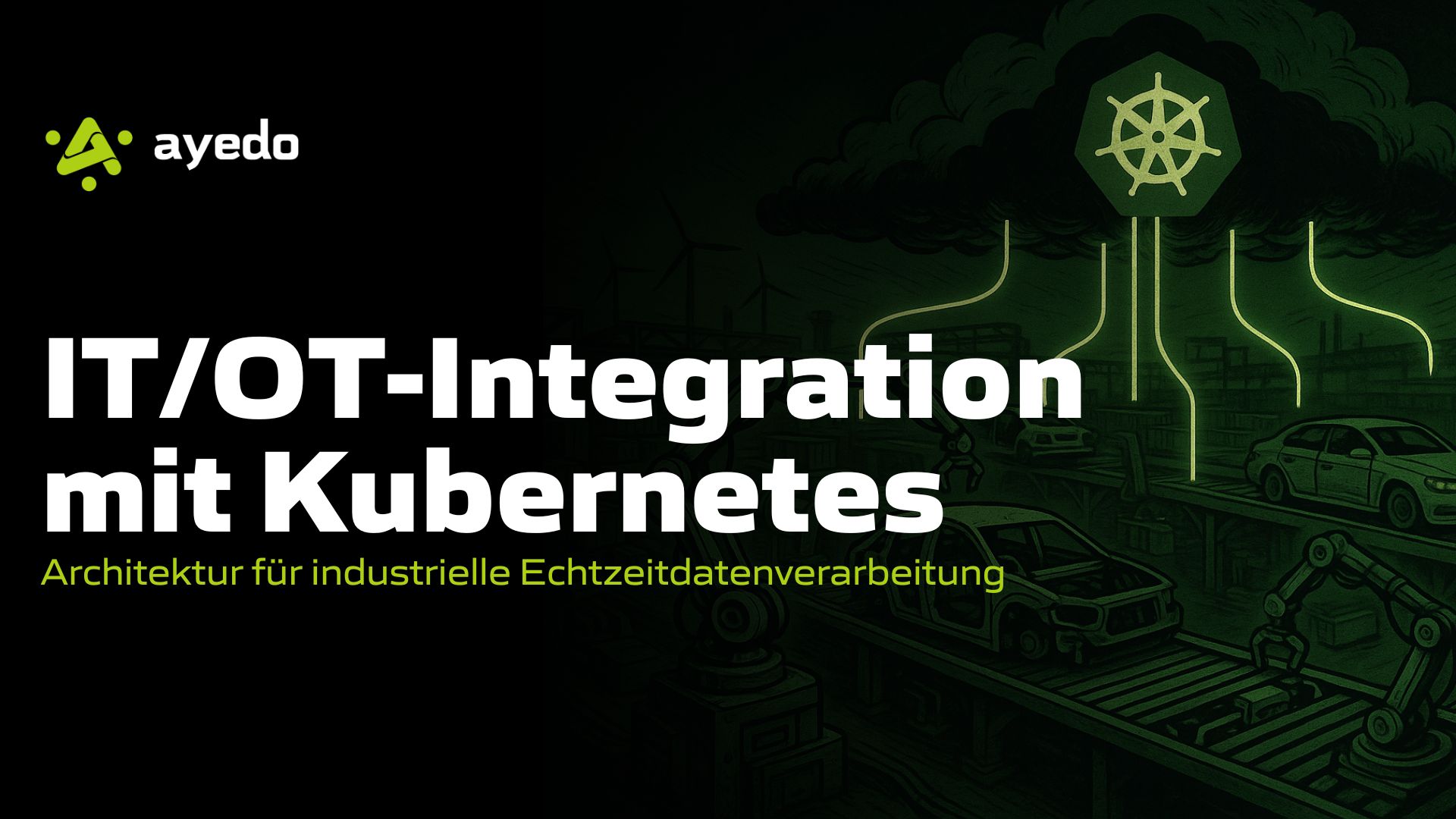
In modern industrial environments, increasingly complex data streams are emerging at the interface between production and enterprise IT. Production facilities, sensors, and machine controls continuously provide real-time data, which is becoming increasingly important for process optimization, predictive maintenance, quality assurance, and business decisions.
The problem: OT systems (Operational Technology) and traditional IT speak different languages. While OT is optimized for stability, low latency, and deterministic behavior, IT operates in a service-oriented, dynamically scalable manner with entirely different requirements for networks, security, and manageability.
The result is highly complex integration projects where production data is laboriously pushed into the IT world via protocol bridges and proprietary gateway solutions. This is precisely where Kubernetes — when used correctly — can deliver a clean, long-term stable architecture.
Kubernetes is often associated with traditional Cloud-Native operations in the IT sector. However, its real strengths — portability, orchestration, service isolation, and full automation — are exactly what is missing in a modern IT/OT architecture. Kubernetes can serve as an abstract control layer that connects both worlds without technically mixing them.
The key to this is a functional separation of layers: Machines remain in their highly available OT world, while Kubernetes orchestrates the data-processing microservices in their own, clearly defined zones.
In the lowest layer, traditional OT components like PLC systems, SCADA servers, sensor clusters, and fieldbuses continue to operate deterministically within their isolated production network. The goal is not to impose new systems but to continue operating existing industrial controls as unchanged as possible.
To make this machine world accessible, a translation layer is introduced: Protocol adapters like OPC UA gateways, MQTT brokers, or edge data collectors normalize proprietary control protocols into IP-based, service-capable interfaces. These adapters form the technical boundary over which IT services can access production data without gaining direct access to the machines themselves.
This keeps the production environment physically and logically segmented, actively protecting against attack vectors from the IT domain.
Directly connected to these adapters is the edge layer. This is where the use of Kubernetes begins. On robust industrial hardware in the production area, minimized Kubernetes distributions like K3s or MicroK8s, specifically designed for edge environments, are deployed.
In these edge clusters, containerized microservices run that locally receive, pre-process, analyze, and aggregate high-frequency machine data. Typical applications at this point include anomaly detection, early warning systems for machine failures, quality controls, and predictive maintenance models.
The central advantage is that initial processing occurs directly at the point of origin. This significantly reduces both latency and bandwidth requirements. At the same time, independence from central IT systems is achieved: Even in the event of WAN failures, local production continues to run fully autonomously.
Only after local pre-processing do aggregated data packets reach the central IT through secured interfaces. This central integration layer is also orchestrated by Kubernetes clusters running in the corporate data center, in a private cloud, or in a sovereign cloud environment.
Here, all connections to ERP systems like SAP, MES systems, business analytics platforms, data lakes, or enterprise reporting tools are found. The connection is exclusively via API gateways, event brokers, or streaming systems, ensuring that central IT requires no direct connection to the production line. The data streams are logically isolated, controlled, and versionable.
Communication between edge and core is fully service-centered. All data streams are mutually authenticated and encrypted. Service mesh technologies like Istio or Linkerd handle mutual service authentication via mTLS, including policy enforcement and traffic auditing.
Central policy engines like OPA (Open Policy Agent) determine who can access what and when — including complete auditability of all system accesses. This maintains a consistent zero-trust principle even as system complexity grows. No service communicates outside defined interfaces.
A fundamental advantage of this architecture is its full automation capability. Both edge clusters and central Kubernetes environments are software-defined provisioned and operated. New locations, production lines, or additional machine clusters can be integrated into the platform within minutes — no individual hardware configurations, no manually maintained gateway systems.
Through continuous deployment pipelines (CI/CD), both containerized applications and the underlying infrastructures can be centrally updated, monitored, and scaled. Each component is version-controlled, rollback-capable, and documented in a revision-secure manner.
By using open technologies, dependency on proprietary gateway manufacturers is drastically reduced. Kubernetes, container technologies, protocol adapters, and policy engines follow open standards and are supported by strong open-source ecosystems.
This not only means technical transparency but also long-term planning security: The platform can be operated with changing hardware partners, independent of individual suppliers or technologies. At the same time, the entire system setup remains controllable and traceable — down to the network level, data streams, and service permissions.
The trend towards IT/OT convergence is already a reality. Production data must be processed in real-time, linked with enterprise data, and made centrally controllable. Proprietary bridge solutions, manual gateway configurations, and rigid integration projects are increasingly reaching their limits.
With Kubernetes, a consistently orchestrable platform architecture emerges that logically separates machines and IT systems, connects them technically cleanly, and offers full automation, security, and scalability. Companies gain not only operational efficiency but also long-term technological independence.
Those who are building IT/OT integration today can hardly avoid Kubernetes as a connecting architectural standard.
The Gap Between Shopfloor and Enterprise IT In more and more companies, IT and OT (Operational …
Most IIoT projects don’t fail because of the machines. The sensors work. The controllers …
Welcome to the ayedo Cloud – your ultimate platform for zero-downtime SaaS app hosting. Designed …