Making Digital Sovereignty Measurable:
How the ayedo Sovereignty Score Provides Guidance Digital sovereignty is politically mandated and …
07.04.2026


France is taking digital sovereignty seriously. The government has announced plans to phase out Windows in administration and replace it with Linux. Leading the charge is the digital agency Dinum, with other key players like the cybersecurity agency and state procurement to follow. A concrete migration plan is expected by fall 2026.
This is not a symbolic step but a structural intervention in the technological foundation of state IT.
Notably, the departure from Microsoft is not surprising. France has been preparing for this course for years. Recently, 80,000 employees of the national health insurance were transitioned from Microsoft Teams, Zoom, and Dropbox to proprietary solutions. With Tchap, Visio, and FranceTransfert, a state-controlled collaboration ecosystem now exists under the name “La Suite.” In parallel, the national health data platform is also set to migrate to a “trusted” infrastructure by the end of 2026.
The political reasoning is clear. Minister David Amiel openly states the issue: dependencies on platforms whose rules, prices, and risks are beyond one’s control are a strategic problem. AI Minister Anne Le Henanff categorizes digital sovereignty not as an option but as a necessity.
This shifts the reference framework in France. The debate is no longer technical but power-political.
This is where the difference with Germany lies.
The arguments that have dominated in Germany for years—costs, complexity, migration risks—do not suddenly disappear in France. They are simply weighted differently. Not as exclusion criteria, but as part of a political decision-making process.
Germany, on the other hand, treats these points as given boundaries. The result is a stable status quo that further entrenches dependencies while simultaneously programmatically demanding digital sovereignty.
France is currently demonstrating that this simultaneity is not necessary.
The crucial point is not whether the migration proceeds smoothly. Large projects of this magnitude are by definition complex and prone to errors. What matters is that France is willing to actively reclaim control over central infrastructures—despite the associated uncertainties.
This creates a political precedent in Europe.
If the transition succeeds, it will become significantly harder for other member states to maintain the argument of impossibility or disproportionality. 2026 could indeed become a turning point for the use of open technologies in European administration.
The real question, therefore, is not directed at Paris, but at Berlin.
Germany has the resources, institutional structures, and technical know-how to seriously consider a similar path. What is lacking so far is the willingness to bear the consequences: restructuring procurement processes, building own alternatives, consciously breaking with established dependencies.
France decides. Germany evaluates.
This difference becomes more visible with each such step—and politically harder to justify.
Sovereignty Begins Not in the Ministry, but in Your Own Stack
The political situation in Germany is unlikely to change in the short term. Major decisions remain sluggish, familiar arguments dominate, and real directional changes are postponed.
That is the reality.
However, the consequence should not be to wait.
Because digital sovereignty does not only arise at the state level. It begins where technologies are concretely used: in companies, in organizations, in their own system landscapes.
And it is precisely there that the most important foundation is often missing: a clear picture of one’s own dependencies.
Which systems are critical? Where is data outside one’s own control? Which providers effectively define one’s own scope?
Many cannot answer these questions reliably.
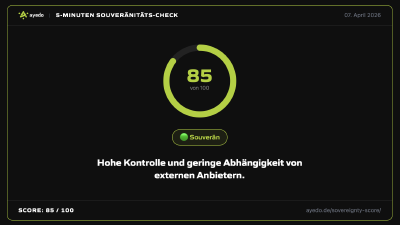
This is why a structured entry is crucial. The Sovereignty Score addresses this and makes dependencies tangible and comparable for the first time. Instead of abstract discussions, it provides a concrete assessment of one’s own situation—across providers, operating models, and levels of control.
👉 </sovereignty-score/>
This is deliberately kept low-threshold. Not a strategy project, not a months-long audit. But a clear first step: understanding where you stand.
And that is exactly what is missing in many organizations.
Not every dependency is avoidable. But every dependency should be a conscious decision—and not a historical side effect.
While states continue to debate, organizations can already begin to analyze and improve their own sovereignty.
Because in the end, digital sovereignty is not decided in political fundamental debates, but in concrete technology decisions.
And those are made every day.
How the ayedo Sovereignty Score Provides Guidance Digital sovereignty is politically mandated and …

What the New EU-US Dialogue Platform Really Means Digital sovereignty has been a focus of political …

In a multi-region architecture for critical infrastructures (KRITIS), data consistency is the …