Docker Swarm or Kubernetes - Which Causes Less Pain?
In many discussions with IT leaders, sysadmins, and architecture decision-makers, a recurring …
06.11.2025
When discussing container orchestration today, two terms quickly come up: Docker Swarm and Kubernetes. Both promise to run containers across multiple machines, scale services, and automate deployments. And because Kubernetes has a reputation for being complex, many organizations initially turn to Docker Swarm, hoping to ease into the world of container orchestration with less effort.
This decision seems reasonable at first glance. Swarm is quick to set up, the syntax is familiar, and the learning curve is gentler. It feels like a natural extension of Docker: a few additional commands, some new YAMLs, and you’re in the world of clusters. But this simplicity is deceptive.
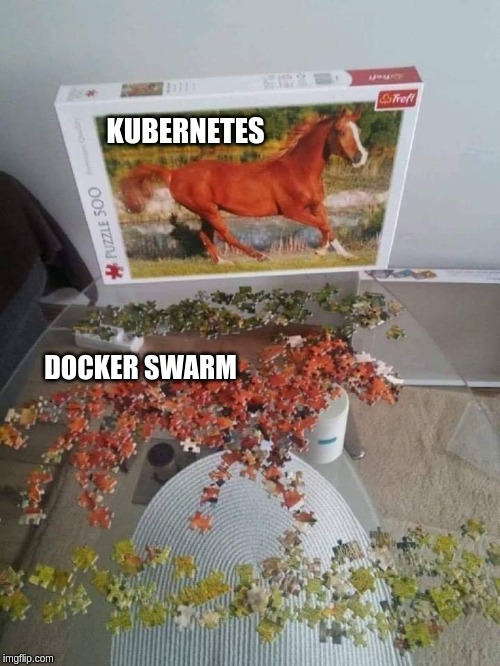
In reality, Docker Swarm is not a “Kubernetes for beginners.” It is an independent, significantly more limited system that offers only a fraction of Kubernetes’ capabilities—and its architecture is fundamentally different at key points. Those investing time in Swarm should know that transitioning to Kubernetes later is not an “upgrade” but a complete technical and conceptual restart.
The fact that Swarm and Kubernetes are often mentioned in the same breath has historical reasons. Between 2014 and 2016, Docker was the central driver of the container movement. When it became clear that containers should not only run on a single host but in entire clusters, Docker introduced its own solution: Swarm.
The idea was compelling: a native part of the Docker Engine, no additional layer, no external scheduler. If you knew Docker, you could use Swarm. The entry was easy—unlike Kubernetes, which was considered academic and heavyweight at the time.
But while Swarm remained simple, Kubernetes evolved rapidly. It became the standard, not because it “can do more,” but because it is built on a different foundation: an architectural model designed for extensibility, resilience, and governance.
Swarm was an orchestrator from the start. Kubernetes became a platform.
The difference between the two systems begins deep in the architecture. Docker Swarm relies on a simple master-worker model, where manager nodes maintain the cluster state and workers execute the containers. Communication is handled via a built-in Raft implementation that keeps the cluster consistent.
Kubernetes follows a more complex but also more robust model. The Control Plane consists of several components—API Server, Scheduler, Controller Manager, and etcd—that work together to manage the cluster state. This decoupling enables high availability, better fault tolerance, and finer control.
Swarm is monolithic, Kubernetes is modular. Swarm understands containers. Kubernetes understands workloads, policies, and resources.
This difference may initially seem theoretical, but it has significant implications in practice. Swarm can start, stop, and distribute containers—but as soon as requirements go beyond this basic mechanism, such as network segmentation, secrets management, complex scheduling, or observability, it reaches its limits.
Kubernetes, on the other hand, thinks in abstractions from the start: Pods, Deployments, Services, Ingress, ConfigMaps, CRDs. It abstracts not only containers but also their behavior and relationships. This creates a language in which infrastructure can be modeled—and that makes all the difference.
Docker Swarm covers a subset of the features that Kubernetes offers. This subset suffices for simple use cases, such as distributing stateless web services or small internal tools. But as soon as you seriously engage with production operations, governance, and scaling, it becomes clear how thin the coverage is.
Some of the key differences can be explained along functional groups.
Deployment and Replication:
Swarm knows services that can be replicated in a specific number. This mechanism works reliably—until you need things like rolling updates, health checks, blue-green or canary deployments. Kubernetes offers native control logic for this, Swarm does not.
Network and Service Discovery:
Swarm uses its own overlay network with internal DNS resolution. This is simple but only works with limited performance and scales poorly across multiple subnets or data centers. Kubernetes allows finely tuned network rules, policies, namespaces, and service types, including integration into CNI plugins.
State Management and Persistence:
Swarm treats volumes rather negligently. There is no native support for StatefulSets or StorageClasses. Kubernetes integrates storage dynamically, with provisioners, bindings, and migration strategies. This is crucial for data-intensive applications.
Security and Governance:
Swarm knows roles and tokens, but no granular rights. Kubernetes relies on Role-Based Access Control (RBAC), namespaces, ServiceAccounts, and policies that precisely define who can do what where. This is indispensable in enterprise environments.
Monitoring and Observability:
Swarm has no native monitoring. Logs and metrics must be collected externally, without a clearly defined API or plugin model. Kubernetes offers standardized interfaces (Metrics API, Events, Probes) and integrations with tools like Prometheus, Grafana, OpenTelemetry.
This list could go on. However, it already shows that Swarm is not a reduced Kubernetes but a completely different system—simpler, yes, but also much shallower.
A common reason to initially choose Docker Swarm is the hope for a gentler learning curve. And indeed: a Swarm cluster is set up in minutes. A few Docker commands, and the first services are running distributed across multiple nodes.
But this head start is deceptive.
Learning Swarm conveys little knowledge that can be reused in Kubernetes. The architecture, terminology, and concepts differ so greatly that a later transition is practically a fresh start. So those who believe they are “preparing” for container orchestration with Swarm are deceiving themselves.
Swarm is quick to understand but shallow in its depth. Kubernetes is initially complex but consistent—once you understand the foundation, you can build everything else on it.
Many teams that start with Swarm soon hit limits: lack of network transparency, insufficient logging, manual scaling, no multi-cluster support. And once these issues arise, they have to migrate to Kubernetes anyway.
The problem is not that Swarm is bad. It is just too small for the tasks companies typically want to solve.
Companies often underestimate the long-term costs of wrong technology choices. Choosing Swarm because it is quicker to set up saves short-term training effort—but leads to increased effort in migration and operation in the long run.
An example: A medium-sized company decides to orchestrate its new microservices with Docker Swarm. After a year, everything runs stably—until centralized authentication, observability, policy enforcement, or automatic scaling is needed.
None of these topics can be cleanly solved in Swarm. The result: parallel operation of tools, individual workarounds, increasing complexity. Eventually, the decision is made to switch to Kubernetes. But now container definitions, deployment strategies, and CI/CD pipelines have to be rebuilt. The knowledge from Swarm is of little help.
The supposedly simple system thus becomes a detour.
Kubernetes often seems unnecessarily complicated to newcomers. It consists of many components, YAML definitions, concepts, and APIs. But this complexity is not an end in itself; it is a reflection of flexibility and security.
Kubernetes is built to meet a wide range of requirements—from small in-house systems to global multi-cloud platforms. It abstracts not only containers but also infrastructure, networks, identities, and policies.
This modularity means that in Kubernetes, you only need to use what you really need. If you want to start simply, you can. If you want to grow later, you can further develop the same platform.
Swarm never offered this evolutionary path.
In corporate or government environments, governance is not a “nice to have” but a prerequisite. It is about traceability, security, access control, and compliance.
Kubernetes is designed for this. Namespaces allow logical separation, RBAC controls access, admission controllers enforce policies, and audit logs document every action.
Docker Swarm does not have these mechanisms in this depth.
Those who need them must retrofit them themselves—which usually means more effort than learning Kubernetes from the start.
Public institutions, in particular, that work with sensitive data do themselves no favors by relying on Swarm. The supposedly lower complexity simply means a lack of control.
Another point is the ecosystem. Kubernetes has developed a momentum in recent years that Swarm never achieved. Almost all modern infrastructure and DevOps tools—from Helm to ArgoCD to OpenTelemetry—integrate natively into Kubernetes.
Swarm, on the other hand, is stagnating. Docker itself has long shifted its focus. Most of the innovation pace today is in the Kubernetes community. So those who choose Swarm are consciously deciding against the direction in which the industry is moving.
This is not only a technical but also a strategic question.
Despite all the criticism, there are scenarios where Docker Swarm is still sensible—provided the expectations are clearly defined.
For small teams running simple applications, Swarm can be a pragmatic solution. If operations are limited to a few nodes, no complex network rules are required, and the environment remains static, Swarm offers an easy entry.
Also, in development environments, test systems, or learning environments, Swarm can play a role. It is quick to set up, consumes few resources, and is ideal for understanding container basics.
But as soon as growth, scaling, or compliance becomes relevant, this comfort zone ends.
The reality is clear: sooner or later, all serious Swarm setups end up with Kubernetes. Not because Kubernetes is “hipper,” but because it is capable of meeting the long-term requirements of modern IT landscapes.
Networks are becoming more complex, security requirements are increasing, multi-cloud strategies are becoming standard, automation is indispensable. All of this can be
In many discussions with IT leaders, sysadmins, and architecture decision-makers, a recurring …
Kubernetes is the Operating System of the Sovereign Cloud Few technologies have fundamentally …
When discussing digital sovereignty and modern IT infrastructures today, Kubernetes is unavoidable. …