

What is the ayedo Cloud?
Welcome to the ayedo Cloud – your ultimate platform for zero-downtime SaaS app hosting. Designed …
27.03.2024

Network security is often neglected, even though it is of high importance! Both in the private and business sectors, often only one tool is used, and even then, it is often unknowingly:

A firewall is a fundamental security feature to protect your network from unauthorized access. It acts as a security barrier between a local and an external network, such as the Internet. Incoming and outgoing traffic is monitored, and based on predefined rules, the firewall decides which data packets need to be blocked. This packet inspection happens in real-time, checking parameters like source and destination IP addresses, ports, protocols, and other header information. If these parameters are on a blacklist (known as black-listing), such as access to an unwanted port, the rule-based filtering kicks in and blocks the packet. Additionally, the firewall logs accesses, providing the administrator with control over potential security incidents. A firewall is integrated into most modern routers, configured by default, and thus protects the user’s network.
However, threats are growing, and so are the requirements for a secure network. Almost daily, successful cyber attacks on companies or authorities make headlines—even though they are better secured than a router-integrated firewall. Of course, home users are usually neither strategic nor particularly lucrative targets, so the risk of becoming the target of a large-scale hack is relatively low. For companies, it’s a different story: Those who can’t pay invoices or salaries due to a hack and subsequent encryption are more likely to pay a ransom than a home user whose vacation photos have been encrypted. Nevertheless, network security is also an important topic for home users. Every IoT device connected to the Internet can become part of a malicious botnet and participate unnoticed in DDOS attacks if the network is not well secured.
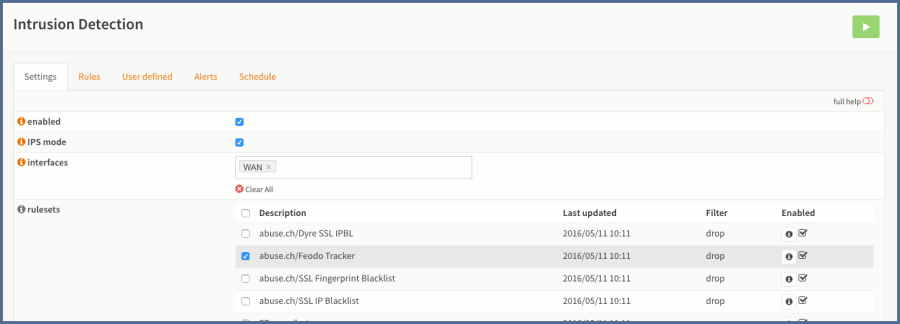
However, there are ways to ensure more network security. Whether for home users, small businesses seeking a cost-effective solution, or larger companies with complex IT security infrastructure requirements: OPNsense can be the answer. OPNsense is a powerful open-source platform for firewall, router, and security applications based on the FreeBSD operating system. It is designed to provide comprehensive network security and management for businesses, home users, and IT professionals. It is a modular and extensible platform offering a wide range of features for network security and management. The focus of development is on user-friendliness, security, flexibility, and extensibility. Even without extensions, OPNsense offers a broad spectrum of functionalities:
 https://opnsense.org/wp-content/uploads/2014/11/feature_idps.png
 https://opnsense.org/wp-content/uploads/2014/11/OPNsense_Dashboard_v16_7b.png
As OPNsense is an open-source project, there are many extensions, add-ons, and plugins available. The platform can thus be tailored to individual needs. For example, if dyndns is needed, a plugin can be installed to provide this functionality.
The advantages are numerous: Even the standard functionality offers a lot of security through features like IPS and can lead to performance improvements through network segmentation or load balancing. Lastly, the very dedicated community should be highlighted, which regularly provides updates and new features.
<div class="text-sm leading-relaxed text-gray-700 dark:text-gray-300">
Interested in network security? We host OPNsense for you! <a href="http://localhost:1313/posts/internal-developer-platform/#:~:text=Fazit-,Kontaktieren,-Sie%20uns">Contact</a> us, and we’ll take care of the rest!
</div>
</div>
Welcome to the ayedo Cloud – your ultimate platform for zero-downtime SaaS app hosting. Designed …

Zero-downtime deployments with Docker Swarm and Portainer Part 2/2 What have we achieved so far? …

In the digitally connected world, constantly logging into various services is more than just a …