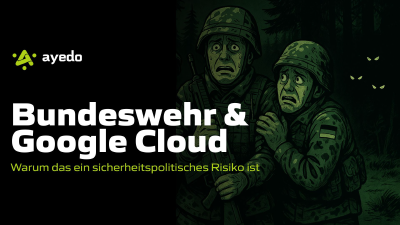
Bundeswehr & Google Cloud: Why This Is a Security Policy Risk
A Technical Project That Raises Political Questions The announcement initially sounded …
28.05.2025

A sovereign cloud requires more than just a data center in Europe. How the CLOUD Act collides with the GDPR—and which technologies enable true data sovereignty.
The idea of a Sovereign Cloud has become a guiding principle in the European IT landscape—especially in the context of data protection, digital independence, and regulatory compliance. However, there is a significant gap between aspiration and reality: While technological concepts for sovereignty are increasingly available, the legal side remains complex and contradictory.
A central area of conflict is the CLOUD Act, a US law that allows US authorities to access data—even if it is stored in data centers outside the USA, as long as it is controlled by a US company. In contrast, the EU General Data Protection Regulation (GDPR) clearly states in Article 48 that data may only be transferred to a third country based on an international agreement on legal assistance.
This leads to a structural problem: Providers with a US parent company are subject to extraterritorial US law, which calls into question compliance with the GDPR—especially when it comes to sensitive or personal data. Even hosting in Europe does not provide reliable protection if the provider is not fully subject to European law.
Technically, sovereignty is not a myth. The issues do not lie in the architecture but in the choice of provider and their legal framework. The following factors play a key role in achieving true sovereignty:
Providers who, by design, do not have access to customer data offer a clear advantage. Techniques such as Confidential Computing or fully isolated infrastructure designs secure data even against access by the operator itself.
With the Sovereign Cloud Stack (SCS), there is an open-source-based cloud architecture specifically developed for European requirements. The stack enables interoperable, scalable cloud environments—including hybrid, public, and private cloud scenarios. The key: A provider change is possible at any time, without vendor lock-in.
Open source reduces dependencies, creates controllability, and allows critical infrastructure to be operated or fully audited independently. Especially for the public sector, this is a practical solution that is gaining increasing importance.
Even in formally open systems, proprietary dependencies, such as with APIs, container technologies, or data formats, often complicate switching providers. In practice, this means: Once you have bought into a platform, getting out is not easy. The much-cited “check-in-anytime-but-never-leave” effect is not a legend but a harsh reality—especially with hyperscalers.
Even though recent measures, such as a new adequacy decision by the EU Commission, aim to temporarily bridge the gap between the EU and the USA, legal uncertainty persists. Data protection impact assessments, compliance audits, and potential legal disputes remain a reality. It is all the more important to prepare technologically and not rely solely on international agreements.
Sovereign cloud infrastructures require more than good intentions. They need technical clarity, legal independence, and real control options. The good news: With open standards, European providers, and a consistent focus on operator and data sovereignty, many risks can be specifically avoided.
The shift towards sovereign IT is not a marketing trend but a necessity for companies and institutions that want to be on the right side of regulatory developments—while retaining control over their digital future.
A Technical Project That Raises Political Questions The announcement initially sounded …
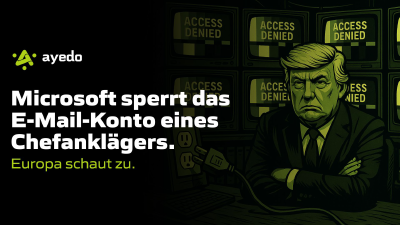
A senior investigator of the International Criminal Court loses access to his emails – because a US …
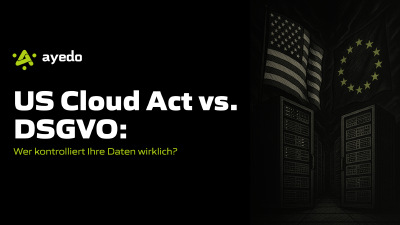
The CLOUD Act allows US authorities to access European data, conflicting with the GDPR. Learn how …