
HAProxy: The Reference Architecture for High-Performance Load Balancing & Traffic Control
TL;DR The load balancer is the front door to your infrastructure. Relying on standard cloud …
26.01.2026
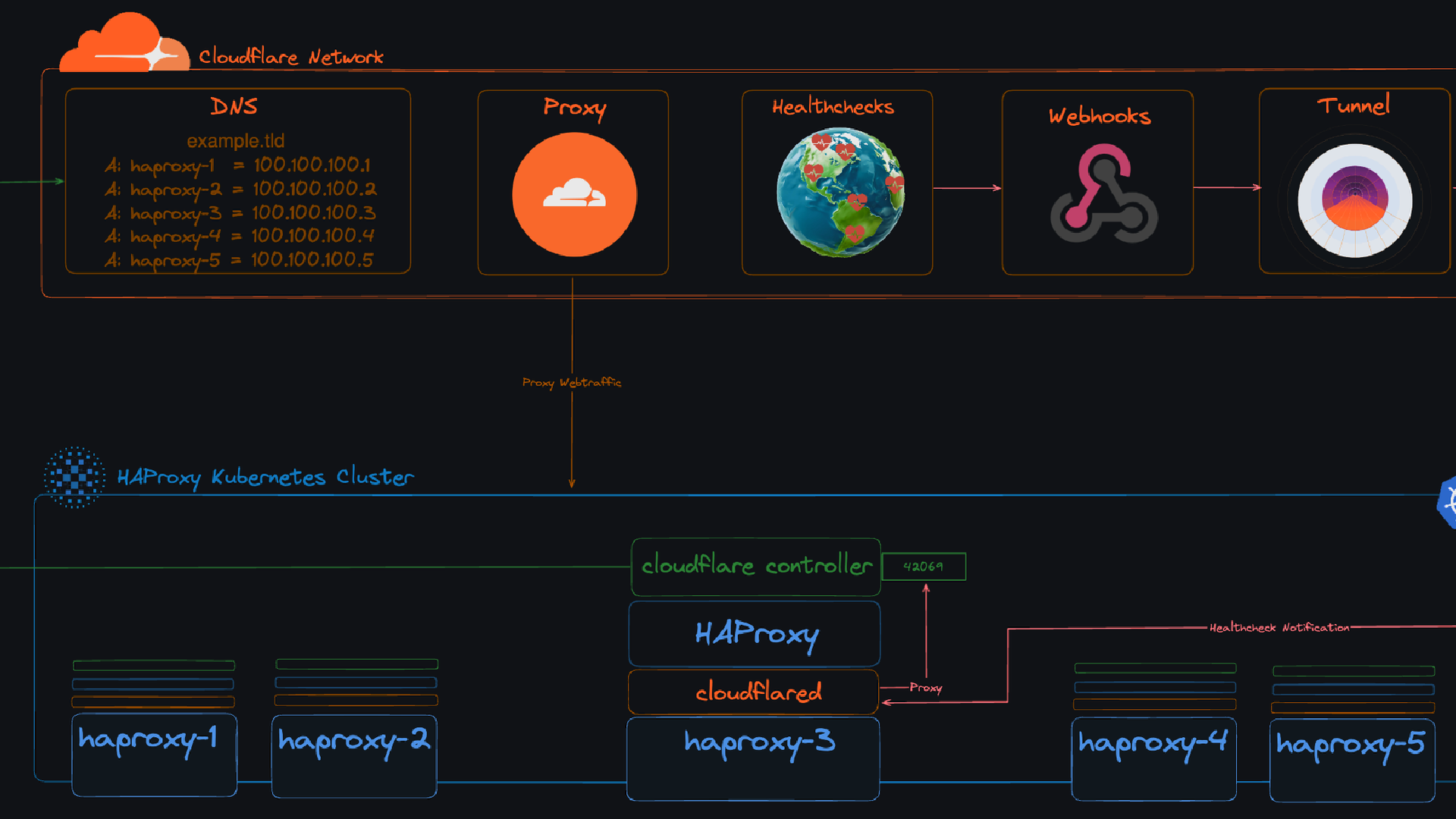
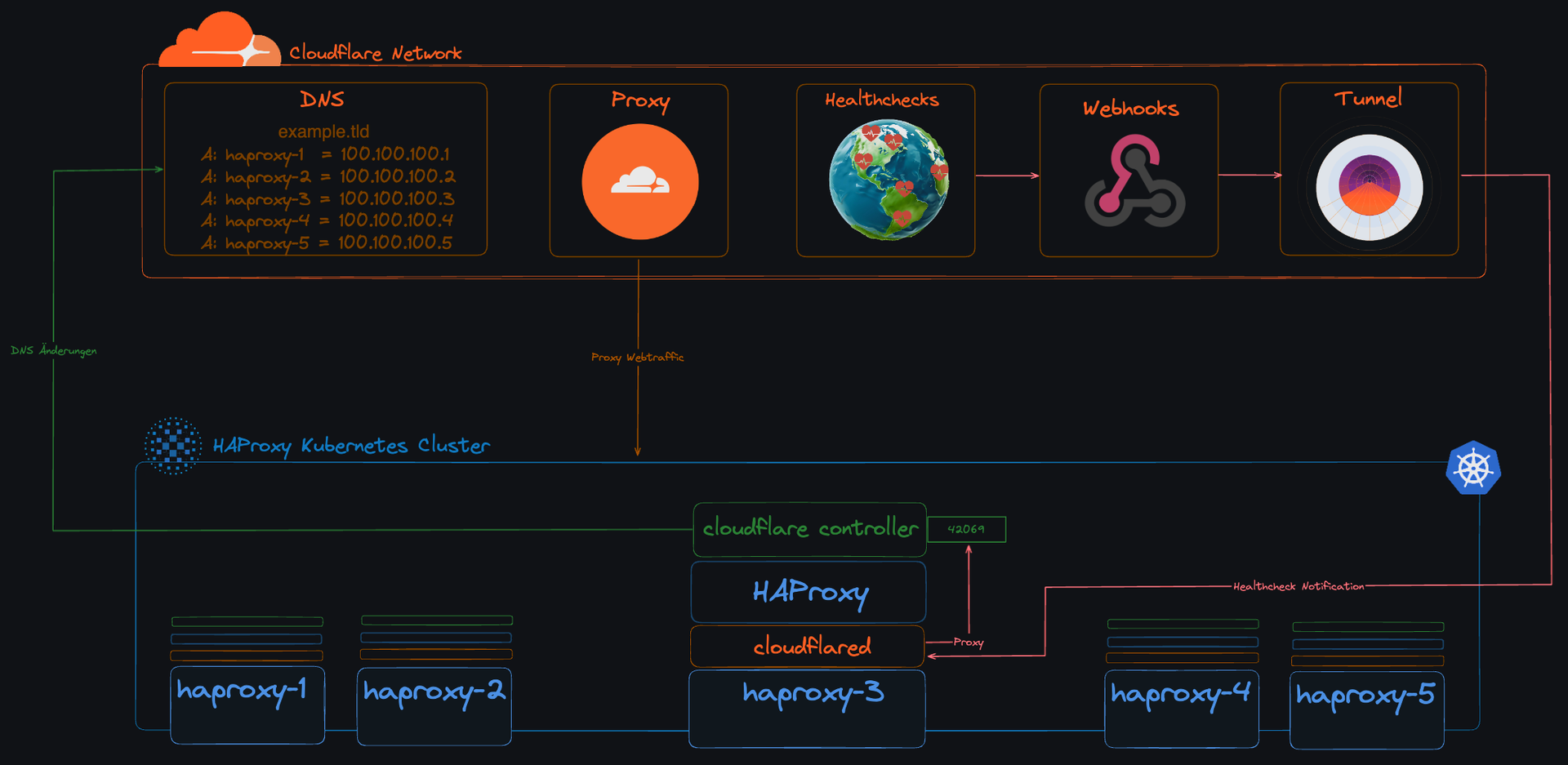
Cloudflare is far more than just a CDN provider. In addition to performance optimization and security features, the platform offers numerous tools that can be creatively used to address individual requirements in modern infrastructure setups—without necessarily relying on the paid Enterprise features.
At ayedo, we have done just that: We use Cloudflare not only for DNS management and traffic proxies but also for our own load balancing concept—without using Cloudflare’s official load balancer features, and with impressive cost efficiency.
Our architecture is based on five independent HAProxy workers that process incoming traffic. User requests are received by Cloudflare’s reverse proxy (the famous orange cloud) and evenly distributed across the IP addresses of the workers.
The challenge: What happens if a worker fails?
Without intelligent routing, Cloudflare would continue to send traffic to an unreachable IP—with corresponding impacts on availability and performance. The logical solution would be to use Cloudflare’s load balancing feature. However, this feature is charged based on the number of DNS queries—an expensive option with high traffic volumes.
A worker failure means that the associated IP must be manually or automatically removed from the DNS zone. The goal was to establish a system that:
The solution is based on a combination of Cloudflare Healthchecks, Webhooks, cloudflared, and a custom-developed Custom Controller for DNS management. And the best part: Everything works with the Cloudflare Pro Plan ($20/month).
Healthchecks Monitor the Availability of Workers:
Cloudflare regularly checks if each worker is reachable. This feature is part of the Pro Plan and can be configured separately for each IP address.
Webhook Notification on Failure:
As soon as a healthcheck fails, a defined webhook is triggered. This webhook runs through a Cloudflare Tunnel (cloudflared) and reaches our infrastructure securely and directly.
Custom Controller Reacts to Healthcheck Events:
Our custom controller receives the notification and automatically removes the affected IP address from the DNS zone—fully API-driven. This prevents Cloudflare from sending further traffic to that worker.
Recovery Upon Return:
As soon as Cloudflare reports the next successful healthcheck, our controller recognizes the availability and reintegrates the IP address automatically. Traffic flows again as usual across all available workers.
Thanks to Cloudflare proxies (orange cloud enabled), changes to DNS entries become effective almost in real-time. There is no waiting time due to TTLs or caching—the redirection to active workers occurs immediately after the adjustment.
This architecture brings several advantages:
What initially began at ayedo as an internal optimization approach is increasingly developing into a scalable platform component. In the future, we plan to offer this solution as an independent, easily integrable service—especially for companies that need high availability but are not willing to purchase load balancing at overpriced query costs.
Cloudflare offers a powerful toolkit—provided it is used creatively. Our setup demonstrates that even complex tasks like load balancing can be solved with intelligent automation and API-first thinking, without buying into expensive billing models.
We focus on robust, transparent, and cost-effective solutions—and this philosophy is exactly what our approach embodies.
TL;DR The load balancer is the front door to your infrastructure. Relying on standard cloud …

Weekly Backlog #47 — Digital Sovereignty? I have a few questions… Editorial Welcome to a week where …

Editorial Digital sovereignty used to be a tech topic. In 2025, it’s power politics: Whoever …