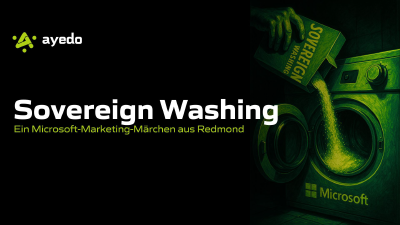
Sovereign Washing - A Microsoft Marketing Fairy Tale from Redmond
Satya Nadella introduced a new “Sovereignty Program” for European Microsoft customers …
16.06.2025

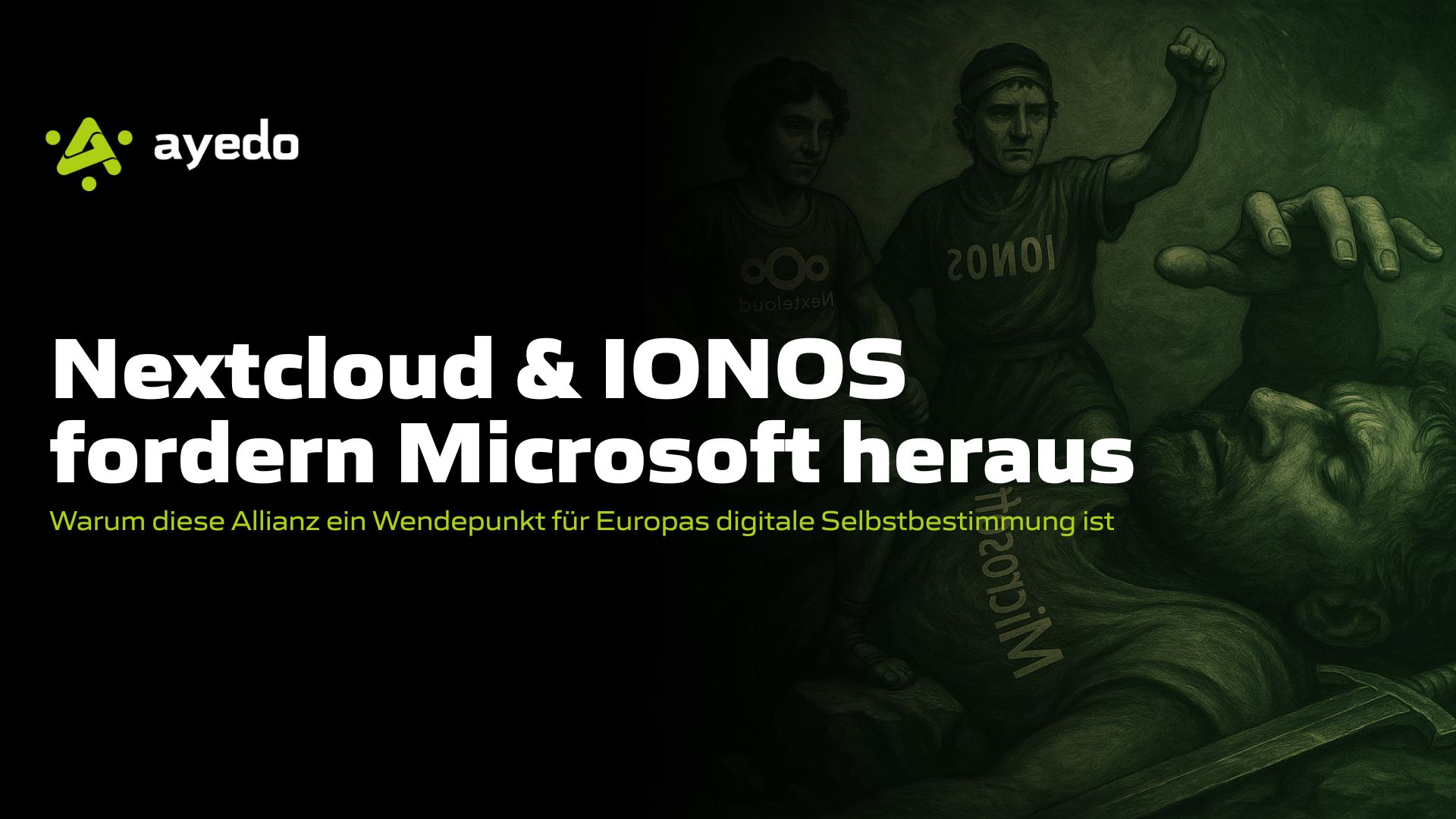
Why this alliance is a turning point for Europe’s digital self-determination
The headline may seem unremarkable, but its content is not: Two German tech companies are joining forces to develop a European alternative to Microsoft 365. What sounds straightforward is, in fact, a clear political, economic, and technological signal.
Nextcloud and IONOS are taking the next step together—sending a strong message for digital sovereignty in Europe. No empty phrases, no marketing labels, no pseudo-guarantees, but: control. Commitment. Responsibility.
Nextcloud, the leading European provider of open collaboration software, is developing a new suite for the digital workplace together with IONOS, the largest European cloud provider with its own infrastructure:
The goal: A real alternative to the US-dominated office ecosystems, primarily Microsoft 365.
According to current figures from Statista, Microsoft and Google together control around 75% of the global market for office software. European solutions have so far played hardly any role in this statistic—despite years of discussions about data protection, loss of control, and geopolitical dependencies.
The reasons are well-known:
At the same time, it is also clear: Those who use Microsoft 365 relinquish control. Not technically—this can be partially compensated by measures like HSMs, key management, or local data storage. But legally.
Because Microsoft is subject to the US CLOUD Act. And that means: Even if data is physically located in Europe, US authorities can access it—without a court order, without informing the affected party. Not even the best marketing campaign for a “Sovereign Cloud” changes that.
The new alliance thinks European—and acts consistently.
What is emerging here is not a clone of Microsoft 365. But a deliberate countermodel.
While other major players from Europe—SAP at the forefront—withdraw from the discussion about European sovereignty, Nextcloud and IONOS show backbone. They take responsibility. Not because it is immediately profitable. But because it is necessary.
Because the question is no longer whether we need digital sovereignty. But only: Who delivers it.
And when.
These two companies show: We can build software in Europe that is competitive. We can operate infrastructure that is secure. And we can rethink collaboration—beyond the American platform model.
What Nextcloud and IONOS have started today is far more than a new product. It is a strategic step. A signal to politics, business, and society:
We have understood. And we are taking action.
Now it is crucial that this initiative does not remain isolated. That it is supported. By customers, by authorities, by system houses, by civil society.
Because those who do not invest today will pay double tomorrow: with dependency, with loss of control, with irreparable infrastructure gaps.
Nextcloud and IONOS are leading the way. The rest of Europe should follow. Companies seriously considering a Cloud-Exit or implementing a sovereign cloud strategy will find an important building block for digital independence here.
Satya Nadella introduced a new “Sovereignty Program” for European Microsoft customers …
The European debate on “sovereign AI” is often reduced to regulation, data protection, …
Hey, I’m Fabian – engineer, entrepreneur, and European citizen residing in Germany. For over …