Inclusion in Tech: The DHHWG and Its Importance for Kubernetes
Introduction In the context of Deaf Awareness Month, the CNCF Deaf and Hard-of-Hearing Working Group …
24.09.2024
In this exciting continuation of our series on Kubernetes, we explore how you can run Kubernetes in Kubernetes (K8s in K8s). Technologies like Kamaji and Cluster API take center stage, along with their integration with KubeVirt. After covering how to prepare Kubernetes on bare metal and transform it into a management system for virtual machines in previous articles, here’s the final touch: With these technologies, you can build a fully managed Kubernetes environment and operate virtual Kubernetes clusters with just one click.
The Cluster API is an extension for Kubernetes that allows managing Kubernetes clusters as custom resources within another Kubernetes cluster.
The main goal of the Cluster API is to provide a unified interface for describing the fundamental entities of a Kubernetes cluster and managing their lifecycle. This enables the automation of processes for creating, updating, and deleting clusters, simplifying scaling and infrastructure management.
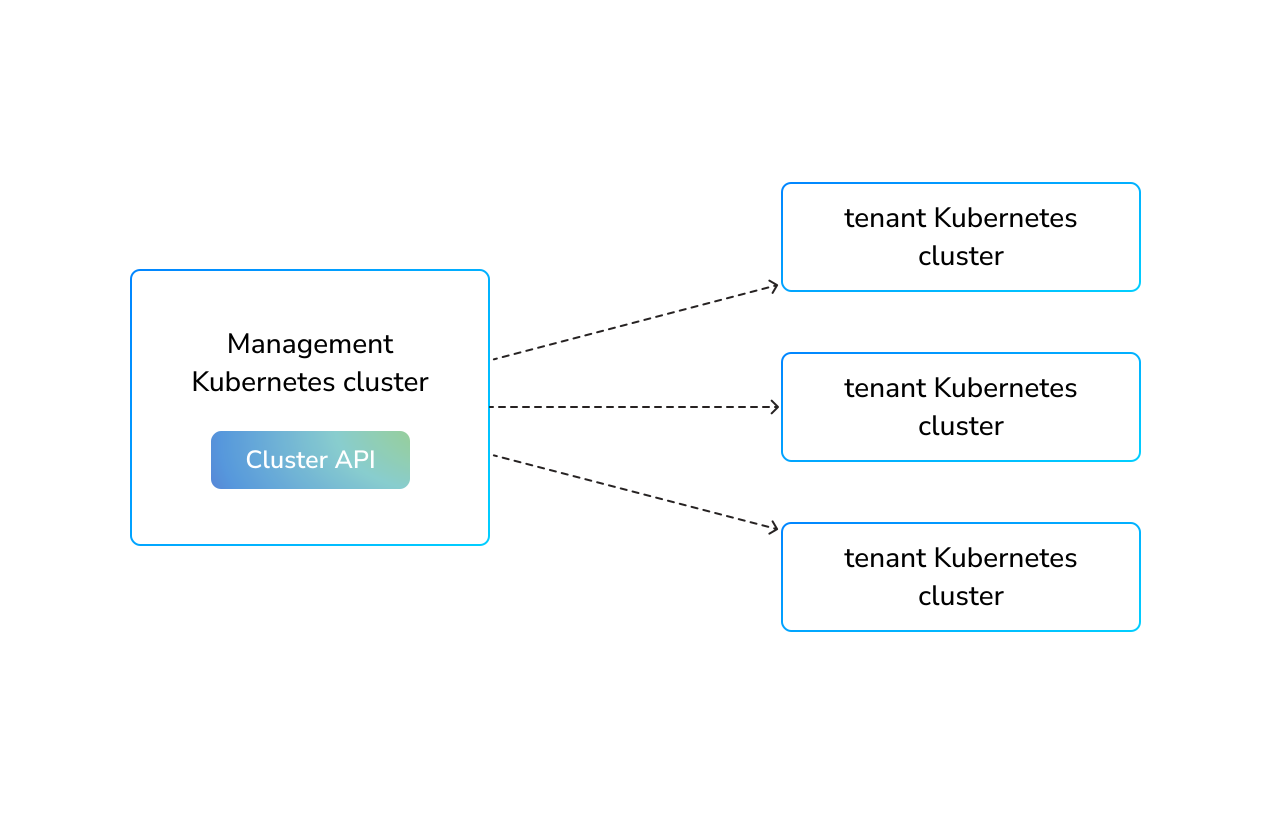
In the context of the Cluster API, there are two terms: Management Cluster and Tenant Cluster.
It’s important to understand that tenant clusters don’t necessarily run on the same infrastructure as the management cluster; they are often hosted elsewhere.
For its operation, the Cluster API utilizes the concept of providers, which are separate controllers responsible for specific components of the cluster to be created. Within the Cluster API, there are several types of providers. The main ones are:
To get started, you need to install the Cluster API itself and a provider of each type. A complete list of supported providers can be found in the documentation.
For installation, you can use the clusterctl utility or the Cluster API Operator as the more declarative method.
To operate Kubernetes clusters using KubeVirt, the KubeVirt Infrastructure Provider must be installed. This enables the provisioning of virtual machines for worker nodes in the same management cluster where the Cluster API is operated.
With these tools and technologies, you are well-equipped to build your own cloud solution with Kubernetes. ayedo is your partner in the Kubernetes world and supports you in implementing these powerful technologies.
Source: Kubernetes Blog
Introduction In the context of Deaf Awareness Month, the CNCF Deaf and Hard-of-Hearing Working Group …
Ten years ago, on June 6, 2014, the first commit of Kubernetes was published on GitHub. This …
Introduction Have you ever thought about creating your own cloud? Maybe you’ve even tried it! …