
What Exactly is an Internal Developer Platform?
Efficiency and scalability are often critical factors for the success of a project in the fast-paced world of software development. A technology that is gaining increasing importance in this context is the Internal Developer Platform (IDP). But what exactly is it, and why should you and your company be interested? In this post, we delve into the basics and benefits of Internal Developer Platforms and provide guidance for selecting the right solution.

Basics
An Internal Developer Platform (IDP) is essentially a set of tools and services used within a company to accelerate and optimize the software development cycle. IDPs are typically configured by Ops teams and used by developers for various tasks such as spinning up environments, changing configurations, and deploying applications. Imagine a kind of toolbox that contains everything a development team needs to work more efficiently. This ranges from code repositories, through Continuous Integration (CI) and Continuous Deployment (CD) pipelines, to monitoring tools and other specialized services.
The main advantage of IDPs lies in the automation of recurring or repetitive tasks and the standardization of development processes. This not only improves code quality but also shortens the time-to-market for new features and updates. The need for manual configuration and coordination is minimized, allowing developers to focus on what matters most: writing high-quality code.
Furthermore, an IDP enables the consolidation of various tools and services into a unified, easily accessible platform. This leads to better clarity and simpler management. In the complex world of modern software development, such centralization can have a significant impact on the productivity and efficiency of a development team.
Why are Internal Developer Platforms Important?
The importance of Internal Developer Platforms (IDPs) cannot be overstated, especially in a time where agility and speed are crucial competitive factors. In 2020, 63% of companies surveyed in the State-of-DevOps Report (p.13) reported using one or more IDPs.
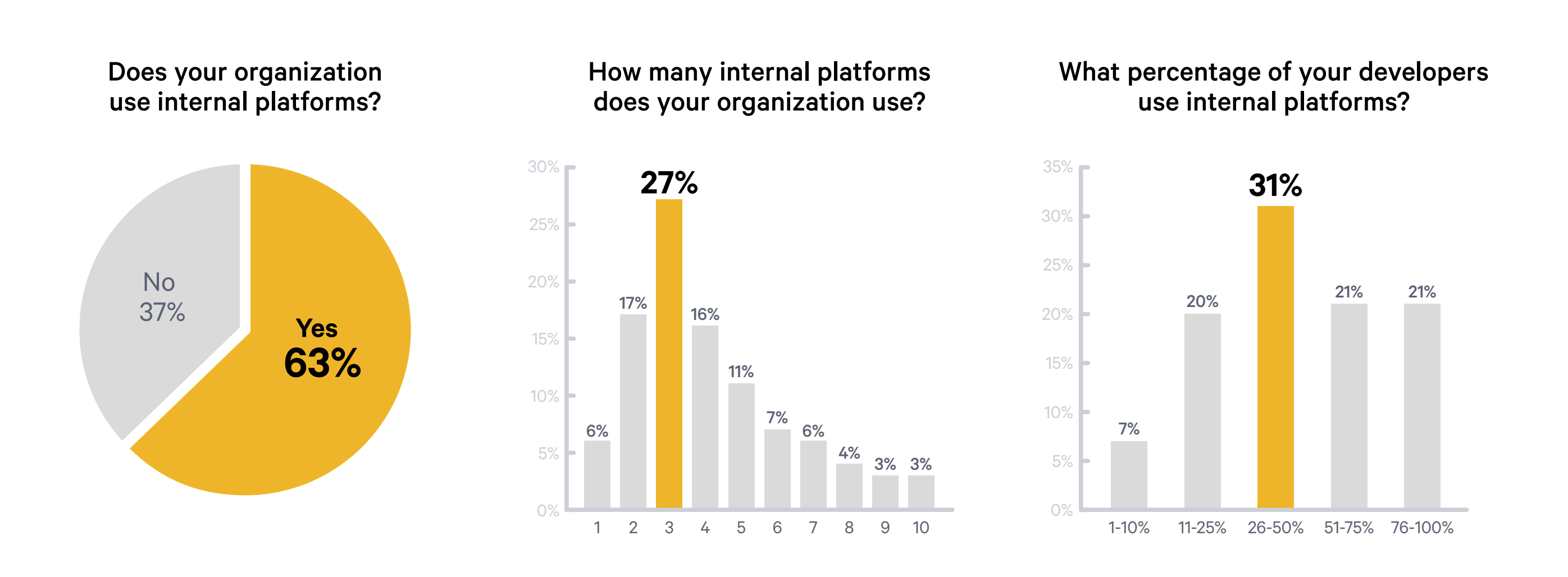
An IDP serves as a catalyst for the DevOps culture by bridging the gap between developers and operations. Through standardized development, testing, and production environments, collaboration within the team is fostered, and silos are broken down.
Another crucial advantage is the reduction of complexity. Modern software development requires the integration of various tools and technologies. An IDP brings all these elements under one roof, significantly easing management. By automating recurring tasks, human errors are minimized, and the quality of the end product is enhanced.
Additionally, IDPs contribute to cost optimization and productivity enhancement. By standardizing processes and enabling more efficient use of resources, companies can reduce their operational costs. This creates financial flexibility that can be reinvested in innovation and growth.
A study by Humanitec underscores these points impressively:
Productivity of the Development Team
- Wait times due to blocked environments decreased by 90%, from 4 hours per week per developer to just 24 minutes.
- The average deployment frequency quadrupled from 1.5 per week to 6 per week.
- The onboarding time for new developers was reduced from 30 hours to 4 hours.
- The lead time decreased from 13 days to 4 days.
Impact on Operating Costs and Developer Support
- The number of developers supported by one Ops full-time employee increased from 8 to 15.
- The weekly time spent maintaining scripts and integrations per Ops full-time employee dropped from 8 hours to 1.6 hours.
- The mean time to recovery (MTTR) was reduced from 6 hours to 1.3 hours.
- The change failure rate decreased from 15% to 4%.
- The onboarding time for a new DevOps employee decreased from 2 weeks to 2 days.
Another, somewhat more qualitative effect of using an IDP is the self-sufficiency of teams. They take over the entire end-to-end process, which increases the level of responsibility and minimizes friction between teams.
Overall, Internal Developer Platforms increase productivity, improve code quality, and enable faster market introduction, which is essential in today’s business world.
Main Components of an Internal Developer Platform
Tools and Technologies
An Internal Developer Platform is an ecosystem of various tools and technologies specifically tailored to the needs of the development team. These tools can range from code repositories and build servers to specialized libraries and APIs. The goal is to provide developers with a set of resources that allows them to work efficiently and with high quality.
Processes and Workflows
In a well-designed IDP, processes and workflows are carefully crafted and automated. This can range from code review to testing to the actual deployment of the software. Automated CI/CD pipelines are often an integral part, as they make the entire process from development to delivery more efficient and error-resistant.
User Interface and Experience
The user interface is not just an aspect of aesthetic design but a crucial factor for productivity. A user-friendly and intuitive interface can ease onboarding and optimize the daily interaction with the platform. The user interface should be designed to be easily accessible for beginners while also supporting experienced developers with extensive features.
Examples of Specific Application Areas
Internal Developer Platforms are used in various industries and contexts. They are particularly useful in fast-paced environments where development teams need to be flexible and agile. These include startups, e-commerce companies, and large organizations undergoing digital transformation. They are also used in projects with high-security requirements to ensure compliance.
Conclusion
Choosing an Internal Developer Platform (IDP) is a strategic decision that can have far-reaching impacts on the efficiency and agility of a development team. With features that cover the entire software development cycle, IDPs enable faster market introduction and higher quality software products. From simplifying complex processes to improving team collaboration, a well-chosen IDP offers significant advantages. For companies seeking to optimize and scale their development activities, the use of an IDP is therefore strongly recommended.
<div class="text-sm leading-relaxed text-gray-700 dark:text-gray-300">
Interested? We are happy to provide you with an efficiently integrated and fully managed <a href="/products/fleet/">Internal Developer Platform</a>. <a href="http://localhost:1313/posts/internal-developer-platform/#:~:text=Fazit-,Kontaktieren,-Sie%20uns">Contact</a> us, and we’ll take care of the rest!
</div>
</div>