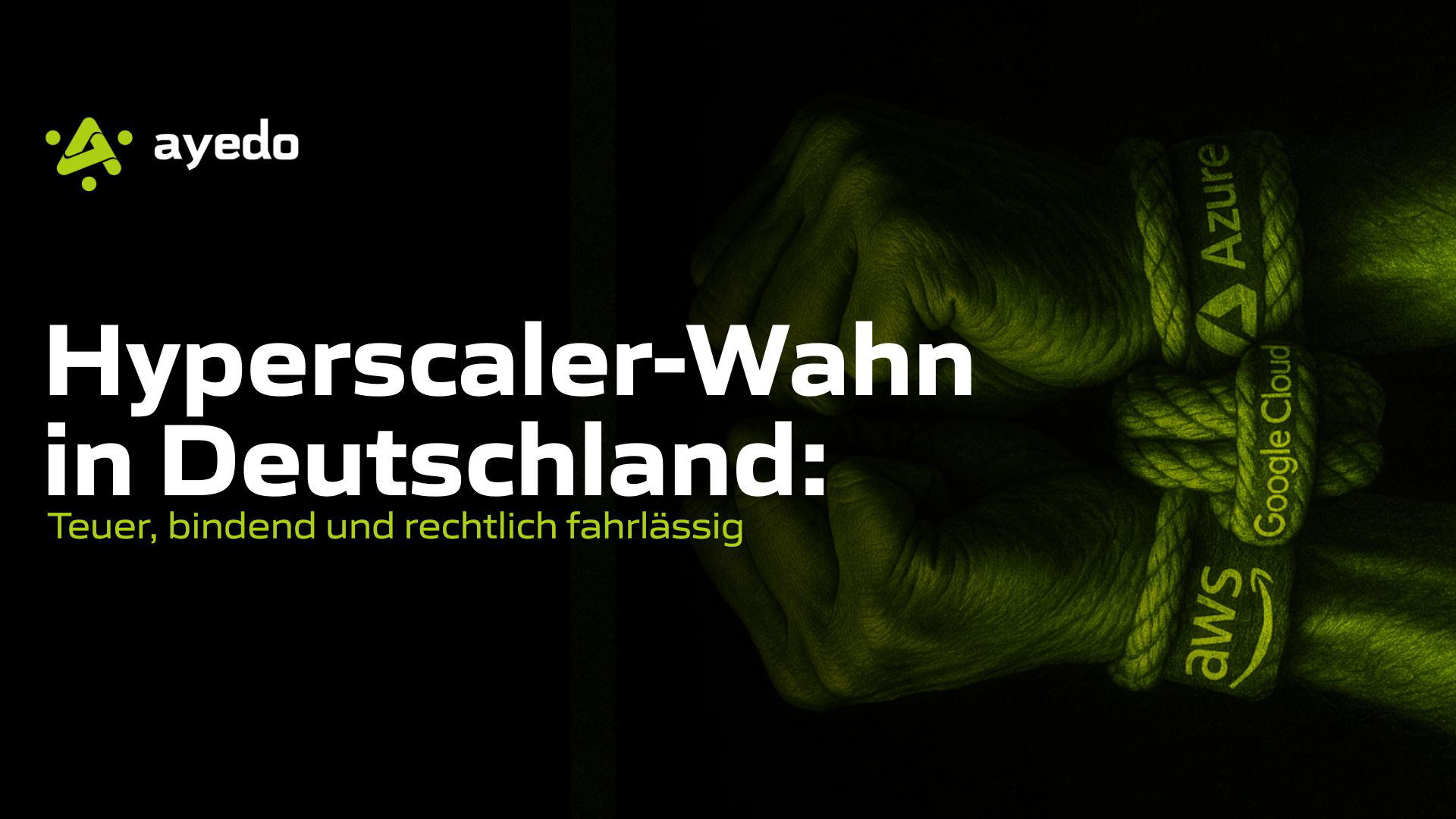
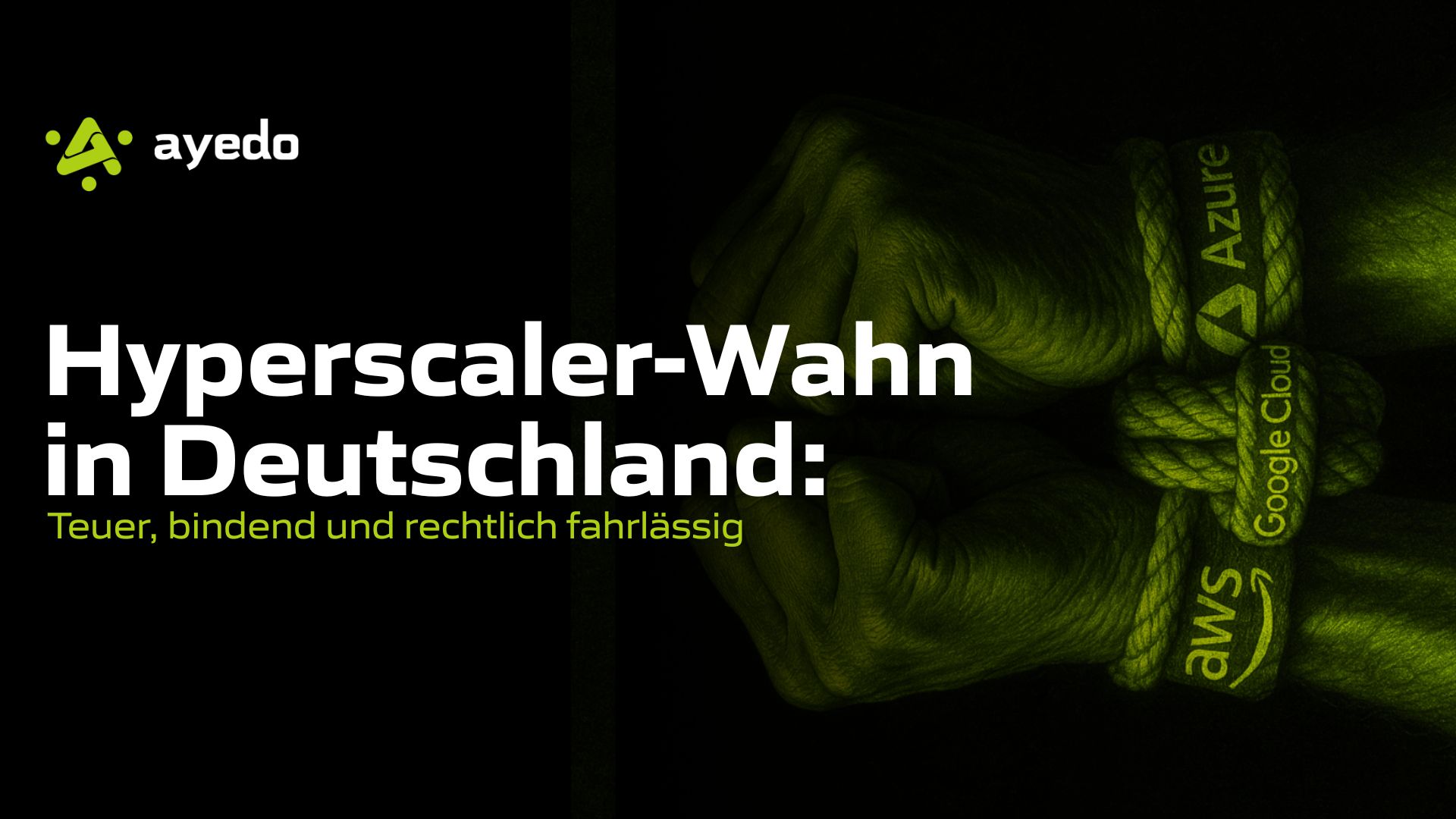
Hyperscaler Madness in Germany: Expensive, Binding, and Legally Negligent
A sober look at the average IT infrastructure in German companies reveals that the technological needs are mostly manageable. Active Directory, SQL databases, an ERP system, a few virtual machines, and an email infrastructure that has been reliably serving for over a decade—this is the reality in the industrial mid-sized sector, healthcare, energy suppliers, and government agencies.
What these landscapes do not need, however, are hyperscaling platforms with global CDN, dozens of regions, serverless functions, BigQuery engines, and GPU farms on demand. Yet, these scenarios are precisely what is happening: companies are booking infrastructure with AWS, Microsoft Azure, or Google Cloud—and paying as if they were scaling the next streaming platform with 100 million users.
What Really Happens: Simple IT, Overdimensioned Cloud
This discrepancy comes at a price—in three ways:
- Financially, because Hyperscalers calculate with complex billing models and premium services that are completely overdimensioned for most customers.
- Organizationally, because with every cloud service, you buy more know-how, more dependency, and more complexity—which hardly anyone internally truly understands.
- Legally, because services from US providers regularly fall under the scope of the CLOUD Act, placing sensitive data outside the control of European legal frameworks.
It is a misconception to believe that choosing the “big three” puts you on the safe side. On the contrary: you buy comfort with a package of non-transparent infrastructure, unclear responsibilities, and high follow-up costs—both technically and regulatorily.
The Myth of the Irreplaceable US Cloud
The arguments for the hyperscalers are usually the same: better scalability, security, performance. But what’s behind it?
In reality, many US clouds offer features that sound impressive but provide no benefit in the everyday life of most customers. Those who neither store petabytes of raw data nor need to make a global product available in 15 zones simply do not need a region-spanning architecture. Those who do not train LLMs also do not need AI-optimized GPUs.
What is needed instead: computing power, storage, backup, high availability—all in a trustworthy environment, at predictable prices, and with contacts who are not on another continent.
And this is precisely what European cloud providers have long been offering. Not just as an alternative, but as a realistic, practical solution—often even with dedicated hardware, lower latencies, and a much more stable data protection foundation.
What ayedo Does Differently—and Why It Makes Sense
At ayedo, we support mid-sized customers daily who are facing the decision: How do I build my IT infrastructure to remain legally compliant, economically viable, and technically flexible?
Our answer is not dogma but an architectural principle: The cloud must serve the company—not the other way around.
For this, we rely on:
- Hybrid and local hosting models, where sensitive data is processed in your own data center or with European partners—without detours through US jurisdictions.
- Open standards and open-source technologies, which enable true interoperability instead of creating proprietary dependencies.
- Transparent consulting, which does not aim at license revenue or vendor lock-in but at sustainable, comprehensible IT concepts.
And: We are certified according to ISO 9001 and ISO/IEC 27001—which means that our processes as well as our IT security measures are not only documented but regularly reviewed and validated. Our customers thus receive not just a promise but a verifiable basis for their own compliance.
Conclusion: Think Smarter, Not Smaller
The reflex to shift everything towards the big US platforms is understandable—but in many cases simply not necessary. Especially companies in regulated industries, with a clear focus on security, stability, and cost efficiency, fare better with modular, European cloud solutions. Not just for political reasons, but because it makes sense both technically and economically.
Because if you’re not Netflix, you shouldn’t host as if you were.
This issue is further exacerbated by the digital sellout of Europe and is particularly evident with the end of support for Windows 10, which confronts German companies with the choice: continue as before or finally rethink.