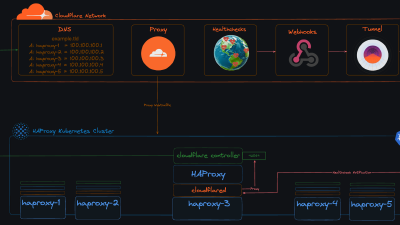
Smart Load Balancing with Cloudflare Healthchecks: Efficient, Robust, and Cost-Effective
Cloudflare is far more than just a CDN provider. In addition to performance optimization and …
30.09.2025


TL;DR
The load balancer is the front door to your infrastructure. Relying on standard cloud services like the AWS Application Load Balancer (ALB) often means paying a “convenience tax.” The billing model is opaque (LCUs), and technical flexibility ends where the cloud GUI stops. HAProxy, the global standard for high-load systems, gives you back control. It offers unmatched performance, granular traffic control, and deterministic costs—as a transparent ingress controller directly in your Kubernetes cluster.
An AWS ALB is a “blackbox.” You don’t know how many instances are running, and you have no influence over caching or TCP optimization. You configure rules and hope AWS scales.
HAProxy is based on an event-driven architecture. It is optimized to handle tens of thousands of connections with minimal CPU and memory overhead.
Cloud load balancers quickly reach their limits with complex logic. An ALB allows only a limited number of rules and simple path forwarding.
HAProxy offers a powerful configuration language based on ACLs (Access Control Lists).
Security starts at the edge. HAProxy acts as an extremely efficient shield in front of your applications.
This is where it is decided whether your costs explode with traffic and how flexibly you can respond to requirements.
Scenario A: AWS ALB (The LCU Cost Trap)
The Application Load Balancer (ALB) is the standard, but the pricing model is tricky.
Scenario B: HAProxy Ingress with Managed Kubernetes by ayedo
In the ayedo app catalog, HAProxy runs as a Kubernetes ingress controller.
Ingress or Gateway API definitions) are portable Kubernetes objects. They work identically on AWS, Azure, or on-prem.| Aspect | AWS ALB (Proprietary) | ayedo (Managed HAProxy) |
|---|---|---|
| Cost Model | Hourly rate + LCU (Variable Costs) | Infrastructure (Fixed Costs) |
| Routing Logic | Limited (Path/Host) | Unlimited (ACLs, Lua, Headers) |
| Performance | Scales slowly (“Pre-Warming” needed) | Immediate (Linear scaling) |
| Rate Limiting | Costs extra (AWS WAF) | Included (Native Feature) |
| Timeout Limits | Hard (e.g., Idle Timeout) | Fully configurable |
| Strategic Risk | High Lock-in (AWS-specific) | Full Sovereignty |
Does HAProxy completely replace the AWS Load Balancer?
Most often, a classic Network Load Balancer (NLB) from AWS is used to direct traffic to the Kubernetes nodes (Layer 4). But all Layer 7 logic (SSL termination, path routing, header manipulation) is handled by HAProxy. This saves massive costs, as NLBs are much cheaper and simpler than ALBs.
Isn’t HAProxy too complex to configure?
The raw haproxy.cfg can be intimidating. In the ayedo stack, however, we use the HAProxy Ingress Controller. You configure it via standard Kubernetes Ingress Resources (YAML). The complex config is generated automatically. For special cases, you use simple annotations in the YAML.
Does HAProxy support modern protocols like gRPC?
Yes, excellently. HAProxy was one of the pioneers in supporting HTTP/2 and gRPC. It can load balance, inspect, and route gRPC calls. This is often a weak point of simpler load balancers.
What about WAF (Web Application Firewall)?
HAProxy has basic WAF functions (SQLi/XSS filters) onboard. For deeper protection, it can be extended with ModSecurity or Coraza (Wasm). Unlike AWS WAF, you don’t pay per request or per rule but have the full computing power of your nodes available.
Performance is a feature, and latency is the enemy. AWS ALBs are convenient, but they mask inefficiencies and tie your costs linearly to your success (traffic). HAProxy breaks this logic. It is the “Formula 1” of load balancers—built for speed, transparency, and absolute control. With the ayedo Managed Stack, you get this power as an easily consumable ingress controller that makes your applications faster and cleans up your cloud bill.
Cloudflare is far more than just a CDN provider. In addition to performance optimization and …

TL;DR In the modern web stack, application code (PHP, Python, Node.js) is expensive and slow. Nginx …

TL;DR The S3 protocol is to data storage what HTTP is to websites: the universal standard. However, …