
Docker Swarm is Not Kubernetes for Beginners
Docker Swarm is Not Kubernetes for Beginners When discussing container orchestration today, two …
06.11.2025
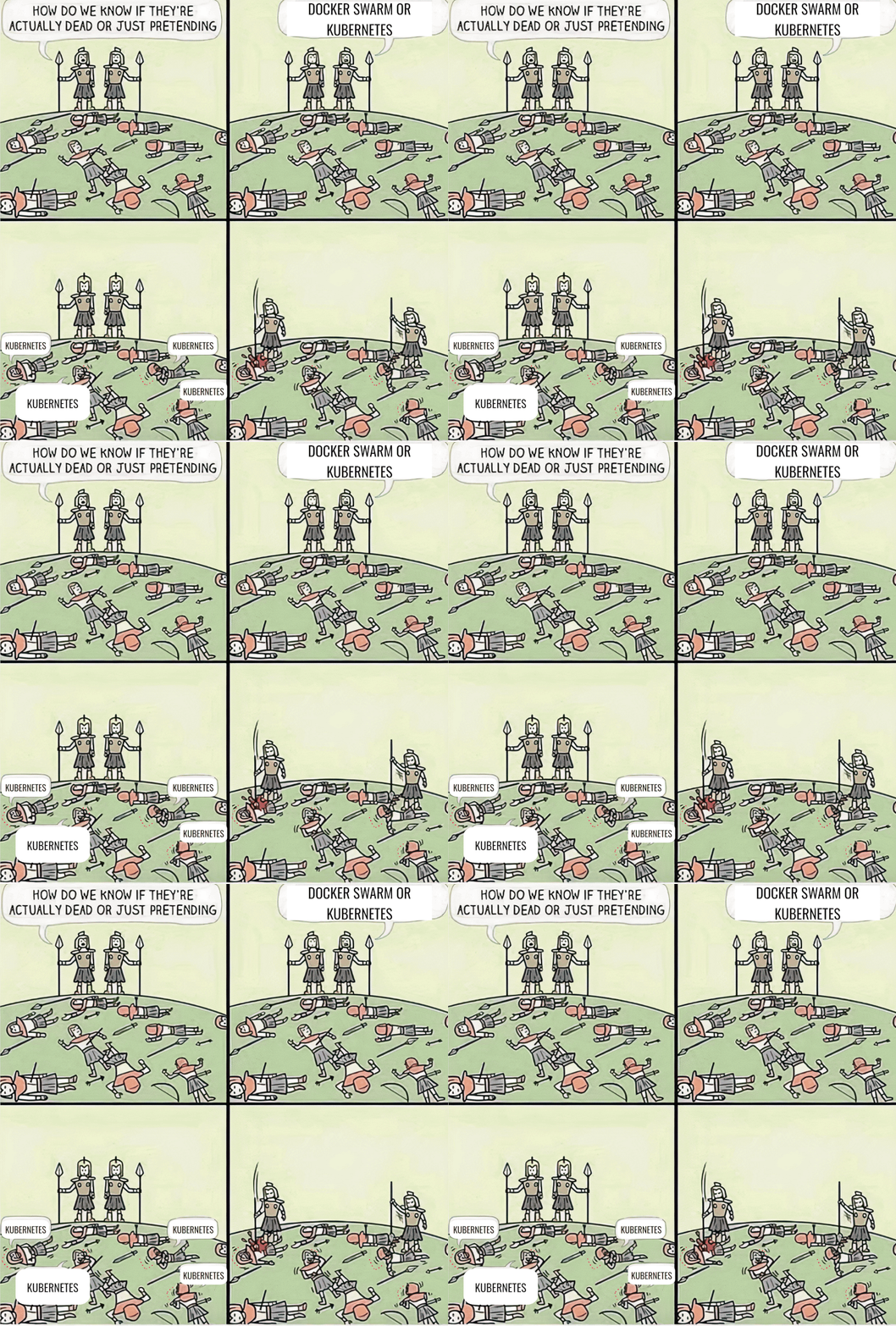
In many discussions with IT leaders, sysadmins, and architecture decision-makers, a recurring pattern emerges: The question of “Swarm or Kubernetes” is not only a technological one but also strategic. Which platform offers less operational pain, more scaling potential, and long-term stability? After years of operational experience, ayedo has a clear preference – Kubernetes. However, this doesn’t mean Swarm lacks validity. On the contrary, one shouldn’t believe that choosing Swarm today as a long-term solution will bypass the Kubernetes learning curve. Eventually, you’ll find yourself with Kubernetes, facing the typical “and suddenly” problems that Swarm brings, especially in larger environments.
Some teams consciously choose Docker Swarm because they want to keep the entry barrier low, start with simple services, or are already familiar with Docker-Compose. The arguments are plausible: Swarm is known, the complexity is lower, and the start is quicker. Examples can be found in comparison articles: On one hand, Swarm is described as a “lighter orchestration variant.”
Even phoenixNAP explicitly states: Swarm offers a quick start, is suitable for smaller environments, and when not all scaling, network, security, or ecosystem requirements are needed.
So if the organization starts with a manageable service portfolio, expects little change, and doesn’t plan for extreme scaling or multi-cluster operations, then Swarm can make sense in the short term.
But here’s where the operational catch begins: As soon as the service scope grows, availability requirements increase, network rules become more complex, observability comes into play, or multiple clusters or geographic distribution are involved, Swarm’s weaknesses become apparent.
Some typical pain points we observe:
From this perspective, it can be argued: Those who start with Swarm today hoping to completely bypass or delay Kubernetes may end up in a technically and organizationally more expensive situation in the medium term.
At ayedo, we recommend Kubernetes for several reasons:
1. Scalability & Availability
Kubernetes offers robust mechanisms for automatic scaling (Horizontal Pod Autoscaler), self-healing deployments, multi-node clusters with control plane failover. These capabilities are either rudimentary in Swarm or heavily dependent on extensions.
2. Ecosystem & Industry Support
The world revolves around Kubernetes: Container runtime, service mesh, operators, CI/CD integration, Istio/Linkerd, network policies – all are much better addressed in Kubernetes.
3. Enterprise-Level Operations and Governance
For companies that need to comply with Compliance, multi-tenancy, observability, and operational standards (Ops), Kubernetes provides mature concepts: RBAC, network policies, pod security policies, extensive integrations. Swarm offers similar approaches but to a much lesser extent.
4. Future-Proofing
Assuming new services, hybrid cloud setups, and dynamic scaling are more the norm than the exception, Kubernetes is the platform with a likely longer investment horizon.
To be fair, there are scenarios where Swarm can be quite sensible – as long as one proceeds consciously and with limitations. Examples:
In all these cases, Swarm can be more quickly usable in the short term. But it must be clear that as complexity grows, the limits will eventually be reached, and migration or switching should still be considered.
For IT leaders, architects, and operational decision-makers: Do not decide based on “Today it’s still small” or “We’ll learn Swarm, then decide later.” Decide based on the future of your operations, on the scalability, stability, governance of your organization, not on the easiest entry hurdle.
If your organization is soon aiming for growth, increased availability requirements, or more automation, then Kubernetes is not only the better choice but probably the only realistic choice. Attempting to start with Swarm and completely exclude Kubernetes can create more effort in the medium to long term than starting with Kubernetes from the beginning.
Docker Swarm has its place – but only in clearly defined, manageable scenarios. Experience shows: Those who want to grow operationally, who pursue scaling, stability, and modern architecture, will sooner or later end up with Kubernetes. And those who are not prepared for it will accumulate technical debt, operational compromises, or even risks.
At ayedo, we believe that infrastructure decisions are not a trend but strategic questions. If your team takes container orchestration seriously, if you want to not only start but grow, then Kubernetes is the way. And yes: We support you in this – with workshops, practical knowledge, operational perspective. No hype promises, but solid preparation of your operations for what’s to come.
If you decide today: Don’t just learn a technology, but create a platform for tomorrow.
Docker Swarm is Not Kubernetes for Beginners When discussing container orchestration today, two …
When discussing digital sovereignty and modern IT infrastructures today, Kubernetes is unavoidable. …
Kubernetes is the Operating System of the Sovereign Cloud Few technologies have fundamentally …