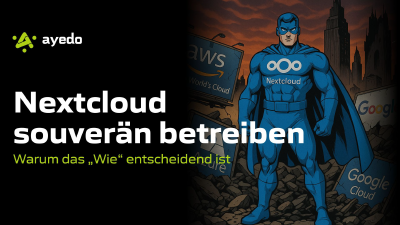
Operating Nextcloud Sovereignly: Why the "How" is Decisive
Nextcloud stands for digital independence, European data protection standards, and an open, …
01.12.2025
The decision by the state government of Schleswig-Holstein to consistently switch its administration to open source software is more than a political signal. It is a real, technically demanding transformation of a complex IT landscape – under full load, with around 60,000 employees, ongoing judicial and administrative operations, and clear strategic goals. This is precisely why this step is exemplary.
The oft-cited phrase “open source is difficult” falls short. The actual statement of this project is: Digital sovereignty is achievable – if you are willing to take responsibility for your own IT.
Since 2024, Schleswig-Holstein has been pursuing a statewide open source strategy affecting central basic components of administrative IT:
This is not a test run in a single agency, but a systemic overhaul of the IT foundation of a federal state.
The article from heise online openly names the challenges: changed user interfaces, adjustment period for employees, criticism from parts of the judiciary. These points are to be expected, both technically and organizationally. They are not evidence against open source, but an expression of how deeply proprietary software is embedded in processes, training, and mindsets.
From a technical perspective, what is crucial is:
A central driver of the decision was not ideology, but cost and risk control. Schleswig-Holstein clearly quantifies the effects:
This is particularly relevant for decision-makers: Open source shifts expenditures from ongoing license costs to investments in competence, integration, and operation.
A structured comparison helps with classification:
| Aspect | Proprietary Standard IT | Schleswig-Holstein Open Source Strategy |
|---|---|---|
| Licensing Model | Ongoing, increasing fees | No license costs, investment in operations |
| Provider Dependency | High (Vendor Lock-in) | Reduced, interchangeable service providers |
| Control over Data | Limited | Fully with the state |
| Adaptability | Limited | High, open source |
| Innovation Path | Set by provider | Independently designable |
| Long-term Costs | Hard to calculate | Predictable |
These differences are directly relevant for administrations, but also for companies with regulated or critical processes.
Particularly interesting for developers and IT architects is the announced next focus: the modernization of specialized procedures as a prerequisite for a widespread Linux workstation. This shows strategic understanding: An operating system change is only sensible if the applications above it move along.
The announced modernization of the E-Akte (Electronic File) solution is a key project in this regard. It decides whether open source can sustainably support not only infrastructure but also specialized logic.
Schleswig-Holstein fulfills several criteria missing in many open source strategies:
For other federal states, municipalities, and also large organizations, this is a resilient reference project. It shows that open source is not a risk, but a manageable architecture and organizational project.
Digital sovereignty does not arise through commitments, but through operational decisions. Schleswig-Holstein makes these decisions – consciously, fact-based, and against short-term convenience. This is exactly what makes this path exemplary.
Anyone who still argues today that open source is not suitable for critical administrative or corporate IT must measure themselves against this project.
Nextcloud stands for digital independence, European data protection standards, and an open, …

TL;DR For a long time, Elasticsearch was the undisputed standard for log analytics and full-text …

TL;DR Artificial Intelligence (AI) is the new standard, but using cloud APIs like OpenAI (ChatGPT) …