
Infrastructure-as-Code with Polycrate: Never Configure SOPS Again
Anyone seriously running Infrastructure-as-Code knows the problem: the workspace in the Git …
23.02.2026


Why ego, responsibility, and reality continue to thwart the dream of ‘shared ownership’.
Over a decade ago, DevOps was hailed as a liberation. A cultural shift meant to tear down the old walls between development and operations. A shared understanding: developers and operations work as one team, sharing responsibility, tools, processes, and goals. Today, more than ten years later, the promise is broken in many organizations. The separation persists—just more subtly. And in many cases, the divide is even greater than before.
In theory, it sounded so simple: cross-functional teams, shared ownership, continuous delivery, shared on-call, infrastructure as code. “You build it, you run it.” A phrase meant to express more than just responsibility—it stood for an attitude. But what often happens in practice is the opposite. Developers develop. Operations operates. And once something is in production, the old reality returns:
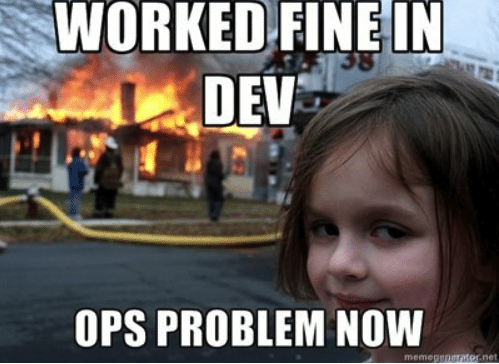
“Worked fine in dev. Ops problem now.”
A phrase that has become a running gag in IT culture—but one that is more serious than it sounds.
Anyone working in operations knows the pattern:
A new release, everything runs smoothly—until it doesn’t. The application hangs, the database is overloaded, CPU spikes, memory usage, timeouts, anomalies. And then? The ops team triages, observes, collects metrics, logs, isolates, analyzes.
The cause? Often not the network, not the hardware, not the platform—but the application itself.
Software-induced problems are the main cause of instability in modern SaaS and cloud systems.
And yet: when the pager goes off, the first glance always goes to the infrastructure.
The root problem rarely lies in tools or processes, but in behavior. DevOps is not a toolset but a mindset, which often never truly arrives.
Developer teams continue to operate largely in isolation. Operations is seen as a service function, not as an equal partner. And responsibility is—despite nice PowerPoint slides—still distributed, not shared. To put it bluntly: DevOps is often just a rebranding of “We deploy more often now.”
This cultural divide manifests in concrete technical patterns visible in almost every operation:
Uncoordinated queries, N+1 queries, inefficient joins, or untested migration scripts that bring production systems to a halt.
Why? Because database behavior is often not realistically simulated in development—local SQLite or test databases simply do not behave like production PostgreSQL clusters with 10,000 concurrent connections. Or there’s a hope that the framework or ORM will optimize everything for performance.
In many teams, memory consumption is not measured, only functionality is tested. A local debugger shows no heap fragmentation, no OOM killer, no cumulative memory accumulation over hours. The result: applications that run solidly on test systems break down in continuous operation.
“It works locally”—but in reality, services run distributed across regions, latencies, networks, queues. Asynchronous communication, event ordering, idempotent operations—still new territory for many developers. But that’s the operational reality.
“I don’t need monitoring, I have a debugger.” A statement that only elicits head-shaking in a production environment. Yet this attitude prevents developers from understanding their systems when they are not running directly in front of them.
In many organizations, there’s a lack of deep understanding of what’s happening beneath the surface—garbage collection, thread scheduling, connection pools, file descriptors, IO blocking. All of this determines stability—and all of this is often ignored in the development reality. The result: software that works in dev but falters in production.
When a system fails, the same ritual usually begins: a ticket, a chat channel, a long night.
Ops analyzes logs, checks resources, tests infrastructure. Eventually, it becomes clear: the cause was a code change. But instead of root cause analysis, the old reflex behavior follows—blame assignment. The result:
Less trust, less collaboration, less communication.
The irony: DevOps aimed for the exact opposite.
Many causes can be named:
But one factor is particularly decisive: ego. Not in the negative sense of arrogance, but in the psychological sense. People identify with “their” code, “their” system, “their” area.
Errors in production are not seen as a shared learning field, but as a threat to one’s competence. The result: defense instead of cooperation.
Today, developers wear hoodies with “DevOps” and manage Kubernetes clusters. But the patterns are often the same. The tools are different, the attitude remains.
People talk about “SRE”, “platform teams”, and “shift left”, but the operational reality looks the same as ever: developers deliver containers, ops ensures they run. Only now the fence between them is made of YAML.
DevOps hasn’t failed—it was just never consistently implemented. The solution is not a new role, another tool, or another Slack channel, but a radical rethinking:
Responsibility must be shared, not passed on.
Errors are systemic, not individual.
Developers need to understand operations.
Not in detail, but in principle.
No code without understanding resources, network, runtime behavior, and scaling.
Operations must be allowed to give feedback.
Not just “record errors”, but co-design architecture.
Observability is a must, not a bonus.
Those who build systems must be able to see, measure, and understand them—beyond the debugger.
Error culture instead of blame assignment.
Incidents are learning opportunities, not career pitfalls.
The goal is not to make developers into operations people—or vice versa. The goal is to create a shared reality. When both sides see the same monitoring, read the same logs, and interpret the same metrics, trust is built. When both conduct postmortems together, they learn from each other. When both have the same KPIs (uptime, performance, deployment success rate), shared ownership emerges. DevOps only works when both sides speak the same language.
In our workshops on Docker, Kubernetes, and operational sovereignty, we see this dynamic repeatedly. Developers with a strong framework focus meet operations teams grappling with infrastructure issues—both talk about the same systems, but in different languages.
We bring both together—in a practical framework where theory and reality meet. We show how containers, observability, and CI/CD are interconnected, and why good software only proves itself in operation.
Because that’s the core of DevOps that many have forgotten: Operations is not an adversary, but an extension of development.
DevOps was supposed to bridge the gap between development and operations. But in practice, it was never fully built—and sometimes there’s someone on both sides with a bucket of gasoline. What we need is not a new buzzword, but a new awareness. Software is not a finished product, but a living, breathing organism that matures in operation. The responsibility for this does not lie in one department, but with everyone working on this system. As long as ego, mistrust, and blame assignment dominate, DevOps will continue to fail—no matter how many CI/CD pipelines are set up.
The future belongs to teams that have learned to share responsibility—in success and in failure. Everything else is just Dev and Ops in new clothes.
Anyone seriously running Infrastructure-as-Code knows the problem: the workspace in the Git …

Anyone working with Polycrate daily inevitably runs into recurring tasks: checking TLS certificates, …

Service or Architectural Decision? CI/CD is often treated as a tool question: Which service, which …