
Guardrails in Action: Policy-Based Deployment Validation with Kyverno
TL;DR Guardrails are automated guidelines around your deployments: They prevent typical …
03.11.2025
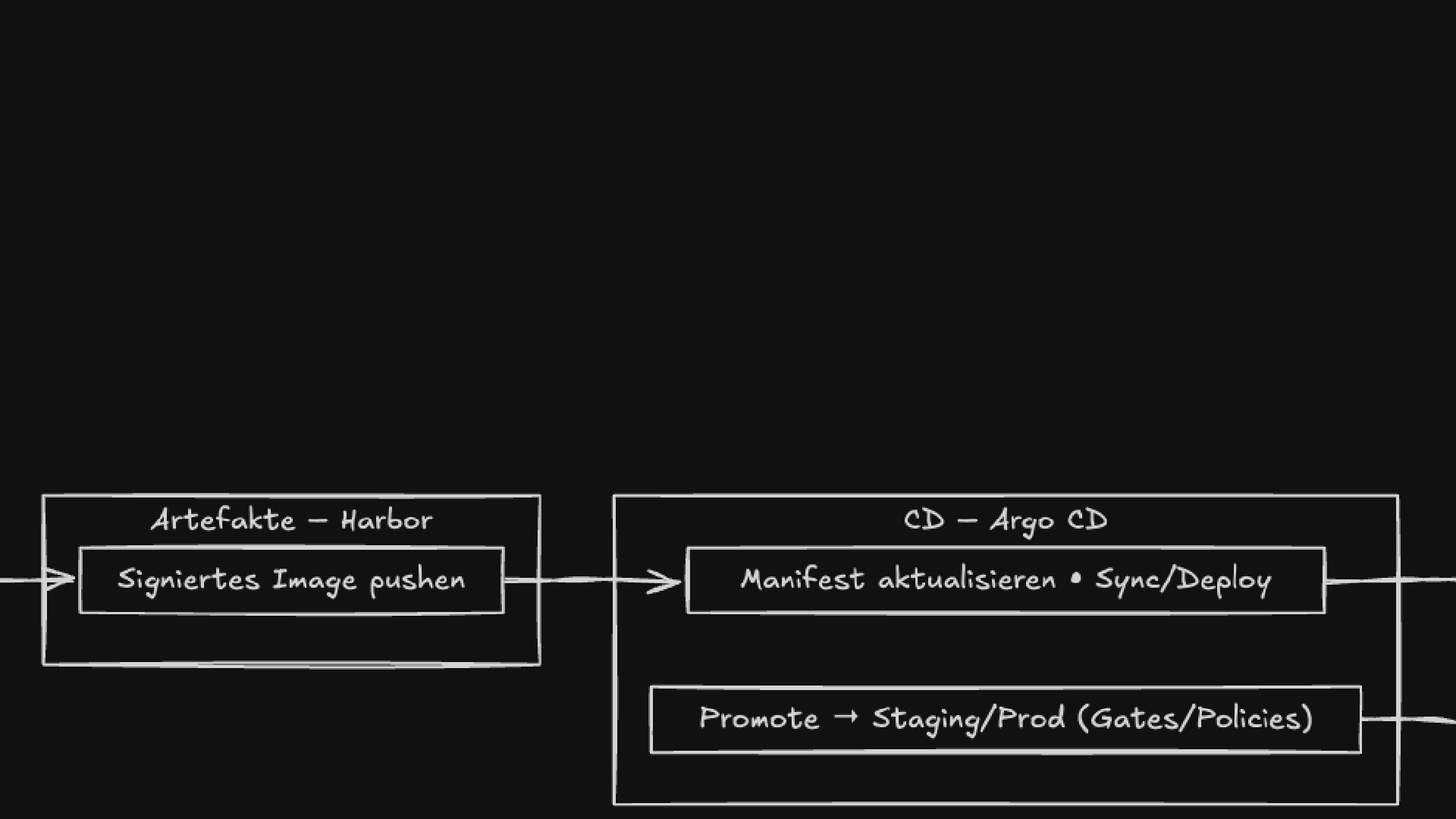

At its core, Developer Platforms enable teams to guide software securely, efficiently, and automatically through the entire Software Development & Delivery Lifecycle. As a Managed Service Provider for cloud-native platforms, ayedo designs these platforms not as a rigid product but as a dynamic infrastructure that responds to customer needs just like a sophisticated GitOps pipeline.
In many companies, development and operations teams work with a multitude of standalone solutions:
At first glance, this seems flexible – but in practice, it leads to massive complexity.
In short: Without a unified Developer Platform, a fragmented landscape emerges where efficiency, security, and speed suffer. For decision-makers, this means rising costs and increased risk; for developers, frustration and slow delivery cycles.
Many providers promise “Developer Experience” but end up delivering only a collection of tools that customers must integrate themselves. ayedo takes a different approach: A Developer Platform as a Managed Service that is not a black box but a foundation for collaborative work.
The principle is simple: “You build it, we run it.” Developers focus on code, features, and innovation – ayedo ensures a platform that works, is secure, and integrates all relevant tools. Instead of burdening teams with assembling a functioning toolchain from countless tools, ayedo relies on a best-of-breed stack that is modular, secure, and proven from the start.
This means specifically:
The result is a platform that not only convinces technically but also relieves organizationally. It provides companies with the assurance that their software delivery processes run on stable, tested, and future-proof structures – without restricting the usual flexibility of the cloud-native world.
A Developer Platform is not a rigid drawer but a spectrum of options that adapts to the individual requirements of a company. Some teams need only a few, quickly available building blocks to be productive. Other organizations require highly customized platforms that meet strict regulatory and technical frameworks.
At the lower end of this spectrum are ready-to-use core components that every modern development process needs:
These services are quickly set up, standardized, and can be immediately integrated into the workflows of development teams.
At the upper end of the spectrum are complex, fully customized platform setups. Here, it’s not just about productivity but also about compliance, security, and regulatory requirements. Examples:
Between these two poles, there are numerous hybrid scenarios: Companies start with a quickly usable identity provider, expand the platform with CI/CD pipelines, artifact management, and secret management – and develop it step by step into a highly integrated environment that also meets strict compliance requirements.
The crucial point: ayedo builds platforms not according to a fixed pattern but modular, iterative, and customer-oriented. Teams can start small and expand their Developer Platform at a pace that suits their strategic goals and regulatory needs.
The ayedo Developer Platform relies on a modular best-of-breed stack that covers the entire software development lifecycle. Each tool fulfills a specific task, but all components are integrated, orchestrated, and strategically aligned.
GitLab is more than a Git repository. It combines code management, continuous integration, security scanning, and issue tracking in one tool. Developers can push changes, start automated pipelines, and incorporate security checks – all in one central workflow.
Harbor manages container images, Helm charts, and other artifacts. Each image is signed and verified to secure the software supply chain. This prevents unsafe or tampered images from going unnoticed into production.
Passwords, API keys, and tokens do not belong in Git or environment variables. Here, Vault or Infisical come into play: They provide zero-trust secret management, storing secrets encrypted, versioned, and injecting them automatically into pods or CI/CD pipelines when needed.
With Argo CD, ayedo relies on GitOps principles: Infrastructure and applications are described declaratively in Git and deployed from this repository. Features like audit-proof rollouts, CVE scans, and SBOM creation ensure transparency and security in every deployment.
Without observability, every platform remains a black box. Prometheus collects metrics, Loki manages logs, and Grafana visualizes both in meaningful dashboards. This way, developers and operators always have an overview of infrastructure, clusters, and applications.
A scalable object storage is the foundation for build artifacts, logs, or machine learning models. ayedo relies on S3-compatible solutions like MinIO, which are highly available, performant, and of course GDPR-compliant.
With Velero, entire clusters or individual namespaces can be backed up and restored in case of an emergency. Point-in-time restores enable a quick return to the operational state before an error or attack – an essential component for business continuity.
A central identity provider ensures single sign-on (SSO) via OAuth2, OpenID, or SAML. It can be connected with existing systems like Active Directory or LDAP and ensures consistent access and rights management across all tools.
Beyond the core components, ayedo provides a Managed Apps Catalog – with over 50 pre-configured applications. These include classics like GitLab, Vault, and Kyverno, as well as modern services like Kafka, Ollama, or ML-specific tools. Customers do not have to set these up themselves but can use them productively right away.
A Developer Platform must not be an isolated island. Its value only becomes apparent when it seamlessly integrates into the customer’s existing IT landscape – whether in the data center, in hybrid scenarios, or in highly specialized environments like OT, edge, or air-gapped setups. This is exactly where ayedo comes in: with a hybrid approach that dissolves silos and creates full interoperability.
The platform can be operated both in existing data centers and in the cloud. It integrates with common technologies like **[V
TL;DR Guardrails are automated guidelines around your deployments: They prevent typical …
TL;DR GitOps describes an approach where Git serves as the central, versioned source for the desired …
Kubernetes has become the de facto standard for operating cloud-native applications. However, with …