The Trojan Horse of the 'Sovereign Cloud'
The Trojan Horse of the “Sovereign Cloud” Why Europe’s new sovereignty is often …
14.10.2025
The discussion about digital sovereignty in Europe is old, but it is more relevant than ever. Especially since the geopolitical and regulatory tightening of recent years, it has become clear that the question of where and how data is processed is no longer just a technical one, but a strategic one.
States, companies, and authorities are beginning to understand that digital independence means more than data protection and requires more than an EU data center.
But while the public debate clings to terms like “Sovereign Cloud,” a crucial point often goes unsaid: True sovereignty is not achieved through marketing labels or new contracts – but through architecture.
What is marketed today as “Sovereign Cloud” is often nothing more than a semantic placebo. Hyperscalers offer European instances of their services, host data in Frankfurt or Paris, add additional encryption layers, and present local partner companies to meet Compliance requirements.
However, the ownership and control relationships remain the same. An AWS “German Sovereign Region” remains AWS. A Microsoft “Cloud Deutschland” remains Microsoft. Control over software, updates, APIs, service availability, and pricing remains outside European sovereignty.
The problem is structural: Data location is not the same as data sovereignty. Whoever controls the platform controls the operation. This holds true regardless of where the servers are physically located.
Therefore, the “Sovereign Cloud” rhetoric of the hyperscalers is legally polished but technically irrelevant. It does not change dependency; it merely shifts it.
No one disputes that AWS, Azure, and Google Cloud are technologically leading. They offer mature, highly automated infrastructures, a variety of services, and an excellent developer experience. Their platforms are synonymous with speed and scalability.
The problem lies not in the quality but in the model. Hyperscalers are closed ecosystems whose primary goal is to integrate and bind their customers. Every additional convenience simultaneously means stronger entanglement.
What begins as comfort – Managed Databases, Serverless Functions, Machine Learning APIs – eventually becomes a cage. Data and workloads are tightly coupled with proprietary interfaces, security models, and service implementations. Exiting becomes expensive or simply impossible.
This dependency is no accident but part of the business model.
Europe has responded to this development, but the response is inconsistent. Providers like Plusserver, IONOS, Scaleway, Exoscale or Linode (the latter now acquired by Akamai) offer sovereign cloud infrastructures with European legal jurisdiction, open-source components, and local support.
Technologically, these offerings are solid. They provide compute, storage, networking, and sometimes managed services – mostly based on OpenStack, Ceph, or Kubernetes.
But their biggest disadvantage is structural: They are too small to appear globally competitive and too heterogeneous to be operated in a standardized manner.
Switching from IONOS to Scaleway or from Plusserver to Exoscale still means: different APIs, different interfaces, different automation. What is missing is a connecting operating system – a common language that works across all cloud providers.
In the public discussion, sovereignty is often confused with autarky. But those who believe independence means not using external providers are mistaken. Sovereignty does not mean isolation – it means freedom of choice.
True digital sovereignty arises when you can freely decide at any time where and how a system is operated without losing functionality or integrity. This requires understanding the cloud not as a monolithic provider but as an interchangeable resource.
This also changes the perspective on cloud architecture: Away from “We are on provider X” to “We orchestrate across providers.” This is where Cloud Brokering begins.
Cloud Brokering means no longer “buying” infrastructure but “brokering” it. A broker is not a provider but an abstraction layer – a technical and operational link between workloads and infrastructure providers.
The goal is not to use all clouds simultaneously but to decide flexibly over them. This can mean:
Cloud Brokering is the opposite of Lock-In.
It means abstracting platforms so that infrastructure becomes an interchangeable building block – orchestrated, automated, controlled.
And the key to this has long been available: Kubernetes.
Kubernetes has quietly sparked a revolution in recent years. It has turned containers into an operating system – a universal API that defines, starts, and manages workloads independently of their environment.
With Kubernetes, the interface between application and infrastructure shifts. You no longer talk to individual clouds but to a standardized layer that can be operated anywhere – on hyperscalers, on European clouds, in data centers, on edge devices.
This means: Whoever uses Kubernetes as a foundation has regained sovereignty over their runtime environment. And this is exactly where ayedo with Loopback comes in.
With Loopback, our Managed Kubernetes offering, we completely abstract infrastructure. Companies no longer have to decide where to run their applications but can dynamically distribute them.
Loopback acts as a cloud broker: It provides a Kubernetes platform that works across different providers, enables standardized deployments, and manages portable workloads.
A company can thus run simultaneously on AWS, IONOS, Scaleway, and its own data centers – without proprietary dependencies.
The crucial point: ayedo itself is not a lock-in. We do not use proprietary APIs but pure Kubernetes standards. If you decide differently later, you can seamlessly migrate your workloads using standardized procedures (e.g., Helm, ArgoCD, GitOps).
That is true sovereignty: freedom of choice through technology, not contracts.
Technology alone does not create independence. Cloud Brokering requires a rethink in companies – away from provider loyalty, towards operational strategy.
The central question is no longer: “With whom do we host?” but: “How do we orchestrate?”
Teams must learn to treat cloud environments as interchangeable resources. This requires automation, unified observability, standardized deployments, and clear governance rules. Cloud Brokering forces companies to develop architectural discipline – and this leads to long-term stability and security.
An often overlooked advantage of Cloud Brokering lies in regionality. Companies can strategically distribute their workloads based on location, legal jurisdiction, or sustainability aspects. A data service can run in Germany, an analytics platform in France, a test environment with a hyperscaler.
This flexibility is not only a technical achievement but a political one. It enables data sovereignty without isolation – and makes regional providers relevant again.
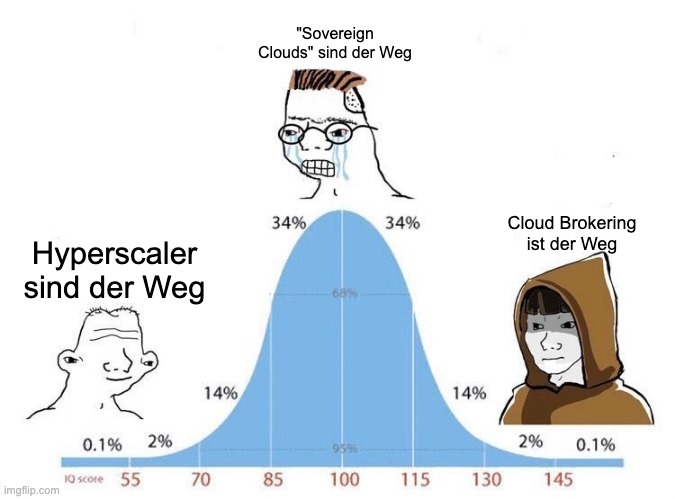
The current debate in Germany is characterized by an artificial dichotomy:
Either you use hyperscalers and forgo sovereignty, or you use European clouds and forgo innovation. Both are wrong. With a Cloud Brokering approach, both worlds can be combined: the technological maturity of hyperscalers and the legal security of regional providers. You don’t have to choose if you orchestrate intelligently.
Infrastructure abstraction has always been the driving force of technological innovation. Virtualization abstracted hardware. Containers abstracted operating systems. Kubernetes abstracts infrastructure.
Cloud Brokering is the next logical step. It abstracts cloud providers. This abstraction does not create a loss of control but the opposite: It enables control to be regained – through open interfaces, standardization, and operational transparency.
True digital sovereignty does not arise from contracts, marketing terms, or national labels. It arises from technical design: through openness, through standardization, and through the ability to decide anew at any time.
Hyperscalers deliver excellent technology, but no independence. European providers deliver legal security, but no scalability. Cloud Brokering combines both – technologically elegant, politically relevant.
With ayedo and Loopback, this strategy becomes operationally tangible. We help companies build their cloud strategy so that it depends not on providers but on architecture. Because sovereignty is not a state of being, but a continuous process – and those who understand it technically need no buzzwords.
Brokering instead of Lock-In. Architecture instead of Dependency.
The Trojan Horse of the “Sovereign Cloud” Why Europe’s new sovereignty is often …
Europe’s Missed Opportunity – and Why It’s Not Yet Lost Over the past decade, the cloud …
European Cloud Platforms vs. Hyperscalers Sovereignty, Scalability, Security, and Strategic Reality …