
Standardized Software Logistics: OCI, Helm, Kubernetes API
TL;DR The Cloud-Native community has established a comprehensive “software logistics” …
15.10.2025
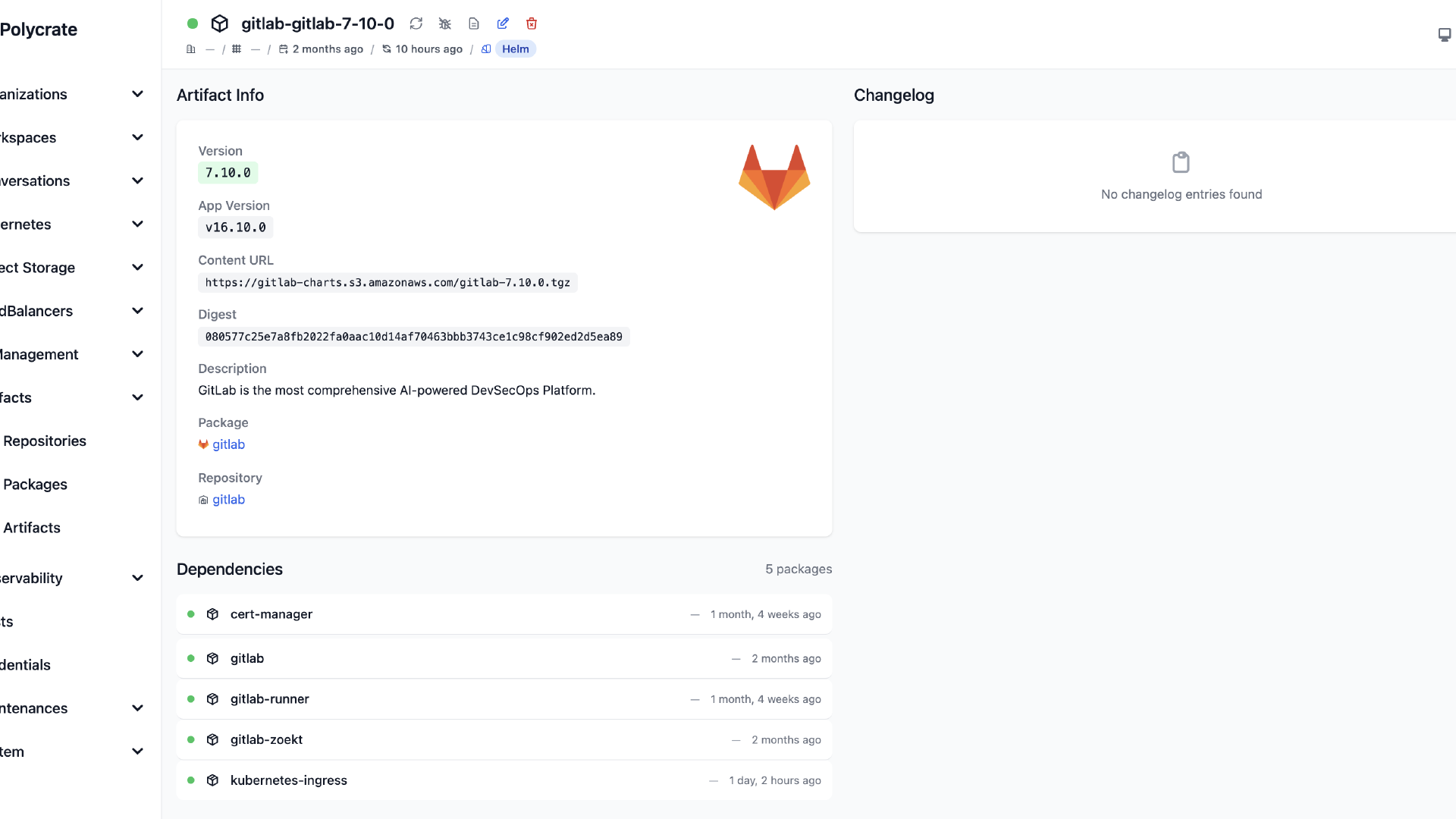
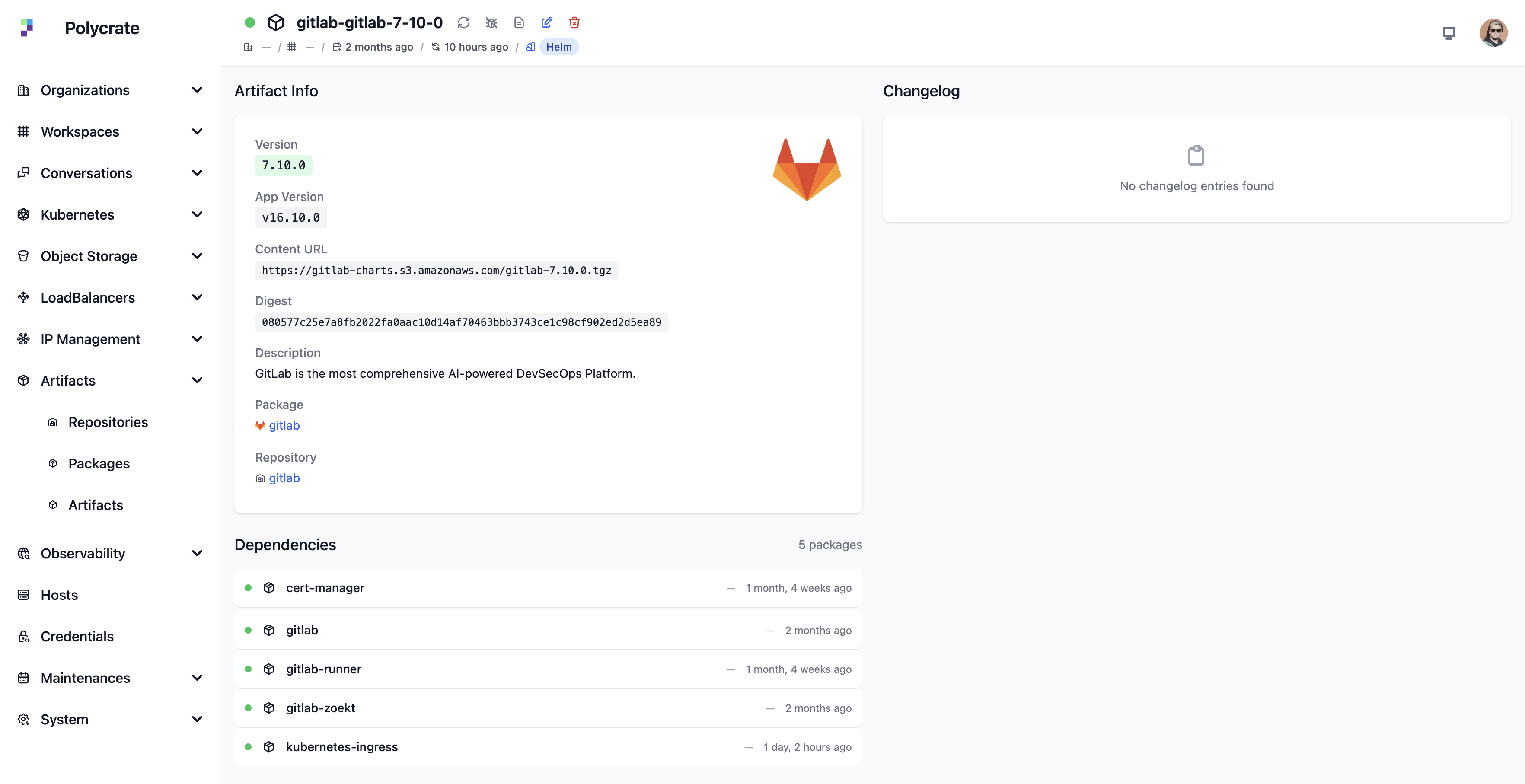
Cloud-native software development is built on a foundation that usually remains invisible: artifacts. These include Docker images, Helm charts, operator packages, and other components essential in modern Kubernetes workflows. Almost every project—from small APIs to complex AI platforms—relies on these packages. But how stable is this foundation really when sourced from the community or third parties without safeguards, mirroring, or governance?
The short answer: not stable enough.
In this article, we delve into the risks arising from the uncritical use of public artifacts and show how companies can establish a robust, secure, and transparent foundation with Polycrate Artifact Management.
Public artifacts are temptingly simple: helm install bitnami/mysql and the database runs in the cluster. But behind this convenience lie several dangers:
The result: Companies risk their software delivery pipelines coming to a halt overnight simply because a third-party provider removes, relocates, or places their artifact behind a paywall.
Bitnami was long considered the de facto standard for Helm charts and images. Whether MySQL, Redis, or Prometheus—many companies relied blindly on Bitnami. But in 2025, the game changed: Bitnami began offering its artifacts only under the tag **latest** for free. Older versions are deleted after 6 months. Full access is only available for a fee (source).
For companies with long update cycles—such as in regulated industries—this is a disaster. Those needing compliance and an old version for reproducible builds suddenly find themselves without access.
Another example is the External Secrets Operator, a widely used tool for injecting secrets from Vault, AWS, or GCP into Kubernetes. The maintainers announced they would cease providing publicly accessible artifacts due to high costs and effort (source).
The consequence: Those who blindly rely on community artifacts must build and host images themselves in an emergency—or lose functionality.
Remember: In 2016, a single developer deleted a seemingly insignificant NPM library called left-pad. The result: Thousands of projects worldwide collapsed (source).
This example starkly illustrates how much the software world depends on often invisible components—and how vulnerable systems are when these components are not secured.
As convenient as it is for users to obtain ready-made images or Helm charts freely from the community—economically, this model is hardly sustainable. Open Source is not a business model, and maintaining complex artifacts requires significant investments. Maintainers must not only write code but also operate build pipelines, sign images, conduct CVE scans, roll out security patches promptly, and provide infrastructure for global downloads. Each of these tasks costs money, time, and personnel.
Many maintainers are individuals or small teams who cannot bear this burden indefinitely. Even large organizations come under pressure: Bitnami, for example, was the most convenient source for hundreds of charts and images for years. But eventually, the realization had to come that this service cannot be provided indefinitely for free. The result: A clear paywall strategy that removes older versions after a few months and makes access to stable artifacts chargeable.
This development is not an isolated case but reflects a broader trend. More and more projects will likely only deliver source code in the future, not the built images or packages. This shifts the responsibility for operation into the hands of the users. For end-users, this means additional work: setting up their own build systems, establishing testing and signing processes, hosting artifacts, and maintaining them long-term.
This is particularly critical for companies in regulated industries. There, reproducibility, traceability, and long-term availability are not optional but mandatory. If a provider deletes old images or restricts access, a compliance gap arises, which can have legal and economic consequences in an emergency.
The bottom line: The number of freely available, regularly maintained artifacts will continuously decrease in the coming years. Those who blindly rely on public artifacts today are building their foundation on sand—and risk that central parts of their software supply chain will simply no longer exist tomorrow.
The reality shows: Those who blindly rely on public artifacts run into complex technical and organizational problems. Without centralized artifact management, the following challenges mainly arise:
Especially in highly regulated industries such as government, banking, or critical industry, production systems must not have direct access to public registries. Developers must then laboriously download artifacts manually, verify them, and transfer them to isolated environments. This process is error-prone, slow, and often contradicts modern automation demands. Without a central mirroring system, massive gaps in stability and security arise here.
Many providers—prominent example: Bitnami—now pursue strict retention policies. Older versions of images or charts are deleted after a few months. For companies with long maintenance and update cycles, this is fatal: If a bug fix is needed or a rollback is necessary, the artifacts are simply no longer available. This creates unpredictable operational risks.
Without central visibility, it is often unclear which artifacts are actually running in Kubernetes clusters, where they come from, and what their security status is. Teams lose the ability to ensure reproducible builds or to prove in an audit which version was used where.
Cloud-native software is highly nested. A Helm chart refers to multiple Docker images, which in turn refer to libraries and base systems. Without a management tool that makes these dependencies visible, the proverbial dependency hell quickly arises: Security vulnerabilities remain hidden, updates can unintentionally destabilize entire toolchains, and compliance requirements are practically unfulfillable.
In short: Without artifact management, organizations lack not only oversight but also operational capability in critical situations.
Polycrate addresses these challenges at the root and provides a platform that professionalizes the management of cloud-native artifacts. The goal is to make the supply chain not only stable but also traceable and secure. Instead of relying on the goodwill of maintainer teams or the availability of individual public registries, companies retain control over their components with Polycrate.
Polycrate seamlessly integrates public and private repositories and can automatically import artifacts. At the same time, these packages are mirrored into their own registries—both for OCI-compliant container images and for Helm charts and Polycrate blocks. This secures the entire supply chain. Especially in air-gapped environments, this mirroring ensures that all necessary artifacts remain locally available without connection problems or security risks from external access.
A central feature is the ability to recognize and display dependencies between artifacts. Polycrate knows that a specific Helm chart requires multiple Docker images or that a block, in turn, refers to another chart. This information is crucial to make security vulnerabilities visible along the entire chain and to apply updates in a targeted manner. Where other systems only focus on the individual artifact, Polycrate understands the entire topology.
Polycrate analyzes which artifacts are actually used in Kubernetes clusters and continuously compares them with available updates and CVE reports. The result is a living inventory of deployed software components, which not only facilitates operations but is also indispensable for audits and compliance evidence. Companies can prove which versions were in use when—a prerequisite for ISO or industry-specific certifications.
The ability to mirror artifacts into own OCI registries solves one of the biggest problems of public providers: short retention policies. While Bitnami removes old versions after six months, organizations with Polycrate retain permanent access to the artifacts relevant to them. This ensures long-term support scenarios or reproducible builds over many years.
Polycrate enables early detection of security risks, triggers automatic alerts for CVE findings, and documents measures. In conjunction with common security tools (e.g., Trivy or Clair), a full-fledged supply chain security pipeline emerges. Companies thus gain the necessary governance over their artifacts: Policies can define which sources are allowed, how long versions may be used, and which images can enter the clusters.
With this set of features, Polycrate transforms the artifact level from an often invisible weakness into a strategic control instrument. Availability, security, and compliance become plannable—and companies escape dependence on random decisions by external maintainers.
TL;DR The Cloud-Native community has established a comprehensive “software logistics” …

TL;DR ohMyHelm is a universal Helm chart wrapper that delivers production-ready workloads without …

The transition from OTRS to Zammad is more than just a technical upgrade for many organizations – …