
Weekly Backlog Week 11/2026
🧠 Editorial Schleswig-Holstein. The real North. is kicking Microsoft out of administration. …
05.03.2026


There are weeks when tech not only makes headlines but causes tectonic shifts. Open Source is losing crucial pillars, hyperscalers are making their dependencies truly expensive for the first time, critical infrastructure repeatedly shows cracks – and while Europe is waking up to security policy, Washington openly uses technology as a geopolitical leverage. In short: The coming years will be less about tools and more about power dynamics.
MinIO is putting its Community Edition into maintenance mode: no active features anymore, security fixes only in exceptional cases. For a project that has been considered a quasi-standard in the on-prem S3 segment for years, this is a significant cut.
More importantly, it highlights a trend that can hardly be ignored: Many OSS projects have long been de facto marketing assets for commercial providers. As long as “adoption” was key, Open Source was a growth driver. Once monetization becomes more important, the open variant falls by the wayside. Bitnami, Elastic, HashiCorp – and now MinIO. The list is growing, and it tells of an ecosystem that no longer operates under the same economic rules as it did five years ago.
Forks like “LibreIO” sound appealing, but a sustainable fork arises not from outrage but from long-term commitment – and that is rare. Realistically, teams should consider the known alternatives: Garage, SeaweedFS, Rook/Ceph, or more modern Rust-based projects.
Those using MinIO productively have no reason to panic. But they certainly have reason to plan.
Links: 🔗 https://github.com/minio/minio 🔗 https://github.com/minio/minio/commit/27742d469462e1561c776f88ca7a1f26816d69e2
As of July 1, 2026, Microsoft 365 products will become significantly more expensive globally: +16.7% for Business Basic, +12% for Business Standard, over +30% for some Frontline plans. Previously, volume discounts were eliminated and on-premises customers faced increased costs. This is not a random accumulation. It is the endpoint of a years-long strategy: deepen dependencies first, then raise prices.
That Microsoft is taking this step so aggressively shows one thing above all: The company has solidified its market position to the point where even significant price increases pose little risk. For governments and businesses, this becomes a problem – not because Microsoft is becoming expensive, but because alternatives were never politically and economically developed.
Europe preaches digital sovereignty while simultaneously binding its digital basic services to a single provider. The bill for this contradiction is now being presented.
Links: 🔗 https://www.microsoft.com/en-us/microsoft-365/blog/2025/12/04/advancing-microsoft-365-new-capabilities-and-pricing-update/ 🔗 https://www.reuters.com/business/microsoft-lift-productivity-suite-prices-businesses-governments-2025-12-04/?utm_source=chatgpt.com
Since December 5, 2025, the national implementation of NIS-2 is in effect. Instead of around 4,500 organizations, 29,500 entities are now under the direct supervision of the BSI – including, for the first time, numerous federal agencies, municipal IT service providers, and medium-sized companies.
Three obligations take effect immediately: registration, reporting of significant security incidents, and documented risk management. For the federal administration, mandatory IT baseline protection is added.
This marks the end of the phase where information security was considered an “IT issue.” NIS-2 shifts responsibility broadly – to areas where there was risk in recent years but little regulation. Many organizations will now find that their security processes not only need improvement but need to be defined in the first place.
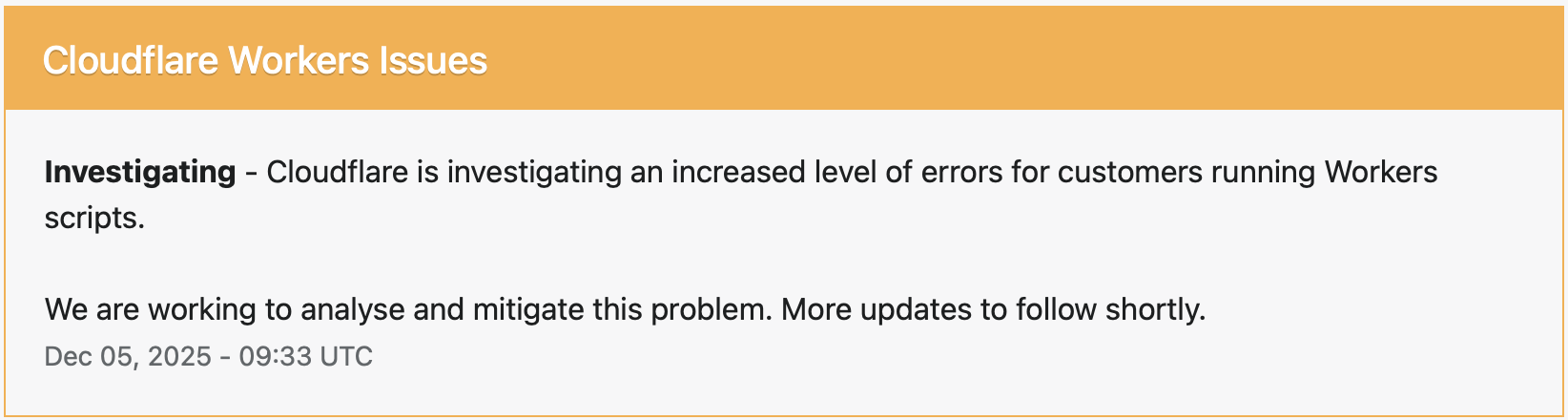
Another global outage at Cloudflare: HTTP-500 errors, websites down, even a malfunctioning Cloudflare homepage. The second major incident within a few weeks – this time allegedly caused by API issues.
The specific error is secondary. What matters is how deeply embedded Cloudflare is in the digital infrastructure. A US service provider has a disruption – and suddenly online commerce, media portals, SaaS products, and public communication in Europe are shaking. This is not a technical problem. This is market concentration.
As long as companies reflexively use Cloudflare while powerful European alternatives remain unused, Europe will remain dependent – and vulnerable. Redundancy is no longer a luxury feature but a question of digital resilience.
Link: 🔗 https://www.heise.de/news/Weltweites-CDN-Offenbar-wieder-Stoerung-bei-Cloudflare-11103942.html
The new National Security Strategy of the USA openly states for the first time that access to technology will be politically conditioned. “More favorable treatment” is to be given to those states that align more closely with Washington’s security policy.
At the same time, European regulations are portrayed as intrusions on democratic principles. This creates an argumentative framework that weakens Europe while strengthening the US position: a Europe allegedly endangering its democracy can hardly credibly claim technological independence.
The real explosiveness lies in the combination: Europe is first rhetorically delegitimized, then technologically pressured. A continent whose digital core infrastructure largely depends on US clouds has little political bargaining power. This is precisely the strategy’s aim.
Links: 🔗 https://www.handelsblatt.com/politik/international/usa-das-sind-die-fuer-europa-wichtigsten-teile-der-us-sicherheitsstrategie/100181919.html 🔗 https://www.n-tv.de/politik/Trumps-Sicherheitspapier-gleicht-Kampfansage-an-Europa-id30112539.html
Pallenberg dissects the term “highly efficient combustion engines,” which is politically often used as an excuse to delay decisions. While German politics debates hypothetical miracle drives, Chinese manufacturers deliver tangible efficiency leaps – exposing the narrative of “technological openness” for what it often is: a placebo for political cowardice.
Particularly bitter: Historically, there have long been better solutions. The Lohner-Porsche wheel hub motor achieved 83% efficiency as early as 1900 – far beyond current “high efficiency” rhetoric.
This discrepancy between narrative and reality is the core of the podcast – and the reason why it is more than a rant, but an industrial policy inventory.
Link: 🔗 https://share.transistor.fm/s/5f004af4
Fabian precisely describes what the sovereignty debate in Europe has missed for years: Labels do not create agency. Architecture does. Workloads that can be operated in a distributed manner, interchangeable infrastructure, and a broker model that keeps both hyperscalers and European providers usable – that is strategic sovereignty.
As long as European projects rely on legal constructs instead of technical interchangeability, sovereignty remains wishful thinking.
Link: 🔗 </posts/cloud-brokering-fur-echte-souveranitat/>
The legal report clearly confirms: US authorities have extensive access rights – even to data physically located in Europe. This means practically every major cloud project of the public sector collides with the reality of US law.
DELOS Cloud, Microsoft 365 in government service, Google collaborations – all of these are based on assumptions that do not hold up legally.
Fuchs clearly shows how large the gap has become between political communication and actual legal reality. Anyone who still claims after this report that US clouds can be operated “sovereignly” is not arguing technically or legally – but purely politically.
Link: 🔗 https://administrator.de/info/rechtsgutachten-us-cloud-datenzugriff-676079.html
Galloway reveals why Amazon, Apple, Google, and Facebook are not just tech companies but power structures that shape the economy, politics, and society. A book that helps to understand the current dynamics – especially in a time when tech is more of a geopolitical tool than an innovation driver.
Thank you for submitting, Philipp Joos

🧠 Editorial Schleswig-Holstein. The real North. is kicking Microsoft out of administration. …

🧠 Editorial: Cloud is political. Period. This issue focuses on a topic often wrapped in technical …

🧠 Editorial: The Week of Sovereignty Simulations This week had it all: operating systems wanting to …